

Traditional SEO metrics such as rankings, clicks, and impressions are increasingly losing relevance in the context of AI search. When answers are generated directly by systems like ChatGPT, Google AI Overviews, or Perplexity, the logic of visibility fundamentally changes:
The key question today is no longer “Where do I rank?” but “Am I part of the answer?”
To measure this new reality, adapted KPIs are required. Below are the most important KPIs that companies should track regularly:
The Core Success Metrics in AI Search
1. Mentions
How often does your brand appear in AI-generated answers—regardless of whether a source is provided?
→ Indicator of basic presence in the AI ecosystem
Why is this important?
Mentions are the first and lowest-threshold indicator of whether a brand appears at all within an LLM’s “relevant set.” Without mentions, there is no visibility—no matter how good your content is.
Example:
A user asks: “What are the best PDF tools?”
The answer includes: “Adobe Acrobat, Smallpdf, and PDF24 are common solutions…”
→ Adobe receives a mention, even without a link.
What this KPI does well:
Measures basic AI presence
Shows whether a brand exists within the AI’s decision space
Early indicator of successful GEO optimization
What this KPI cannot do:
No insight into quality or sentiment (positive/negative)
No indication of influence on decisions
No differentiation between prominent and incidental mentions
Conclusion:
Mentions are a necessary but not sufficient KPI. They show visibility, but not its actual impact. However, they help identify content and topic gaps that can be expanded to increase AI presence.
2. Citations
How often is your content actively used as a source in AI-generated answers?
→ Indicates whether content is considered a trustworthy foundation
Why is this important?
Citations are the strongest quality indicator in AI search. They show not only that a brand is “known,” but that its content is actively used to answer questions.
Example:
A user asks: “How does a PDF editor work?”
The answer includes: “According to Adobe, users can edit PDFs with Acrobat…”
→ Adobe is used as a source.
Important:
A distinction is made between implicit citations (as in the example) and explicit citations with clickable links.
What this KPI does well:
Measures trust and authority
Strong indicator of content quality
Shows actual usage of content; explicit citations can also generate website traffic
What this KPI cannot do:
Can be disproportionately influenced by a few strong pieces of content
Does not capture full visibility of all mentions
No direct insight into brand perception
Conclusion:
Citations show whether content is not just visible, but relevant and trustworthy. This creates clear levers: content can be optimized to be cited more often, and gaps can be closed to build authority in key topics.
3. Sentiment
How positively or negatively is your brand portrayed in AI-generated answers?
→ Critical for perception and brand impact
Why is this important?
AI systems reflect existing narratives. The sentiment KPI shows what kind of image of a brand is embedded in the model and gives insight into what users perceive.
Example:
“Adobe Acrobat is powerful but expensive…”
→ Mixed sentiment: negative perception of price, positive perception of quality.
What this KPI does well:
Measures brand perception
Early indicator of reputation risks
Steering metric for content strategy
What this KPI cannot do:
Subjective and fluctuating
Prompt-dependent
No direct business impact
Conclusion:
Sentiment shows how a brand is evaluated by AI—not just whether it is found. This enables targeted actions: addressing negative narratives and improving perception through strategic content and branding efforts.
4. Visibility Score / Share of Voice
How visible is your brand compared to competitors across multiple prompts?
→ Should be evaluated over time due to fluctuations
Why is this important?
The visibility score aggregates mentions across a defined prompt set and makes trends measurable. It shows your relative position in the AI landscape.
Important note:
Highly dependent on the selected prompt set (topics, phrasing)
Individual measurements fluctuate → trends over time are key
What this KPI does well:
Enables comparison over time (trend analysis)
Benchmarking against competitors
Measures success of GEO initiatives
What this KPI cannot do:
No insight into quality (sentiment) or trust (citations)
Can be biased by prompt selection
No direct insight into traffic or business impact
Conclusion:
The visibility score shows relative market position—but only within a well-defined prompt set.
Approach:
Define a stable, representative prompt set (use cases & intents)
Track mentions per prompt regularly
Weight prompts into an index (e.g., share of mentions)
Compare with competitors and focus on trends rather than single data points
5. Competitive Benchmarking
Which brands are mentioned alongside yours, and who dominates specific topics?
→ Shows real competition within AI answers
Why is this important?
AI search is a competition for answer space. Competitive benchmarking reveals who currently owns the narrative in specific topics.
Example:
A user asks: “What are the best PDF tools?”
The answer includes brands like Adobe, Smallpdf, PDF24.
→ These brands form the actual competitive landscape in AI.
What this KPI does well:
Identifies new (often unexpected) competitors
Reveals topic ownership and gaps
Provides a foundation for strategic positioning
What this KPI cannot do:
No insight into brand perception (sentiment)
No direct link to traffic or conversions
Dependent on the prompt set
Conclusion:
Competitive benchmarking shows who you are truly competing with in AI—not just in traditional markets. This enables targeted differentiation and the identification of underutilized topics for quick visibility gains.
6. Agentic Traffic
Are AI systems and agents accessing your content?
→ A completely new form of usage
Why is this important?
Agentic traffic is generated by autonomous AI agents that analyze data, make decisions, and perform actions (e.g., research, comparison, even purchase preparation)—often without a direct human click. Unlike mentions, which reflect visibility, agentic traffic shows active usage of content.
Key considerations:
Growth: Increasing rapidly with tools like ChatGPT (browsing/agents), Perplexity, and others
Agentic commerce: Agents may pre-select products or initiate steps in the buying process
Different behavior: Faster, more targeted, often API-driven → new requirements for tracking and infrastructure
Implication: Visibility shifts partly into a “machine layer” beyond traditional clicks
Example:
An AI agent aggregates information on “best PDF tools,” retrieves content from adobe.com, and uses it to build a structured comparison.
→ Content is actively processed without a direct user click.
What this KPI does well:
Shows whether content is actively accessed by AI systems
Early indicator of relevance in agentic workflows
Complements traditional traffic metrics
What this KPI cannot do:
Difficult to clearly distinguish (user vs. bot/agent)
No direct insight into human interaction
No immediate business impact
Conclusion:
Agentic traffic shows whether your content exists in the “machine layer.” This opens new levers: optimizing APIs, structured data, and crawlability for AI accessibility.
7. Referred Traffic
Is traffic coming directly from AI systems?
→ Measures the actual impact of AI visibility
Why is this important?
Referred traffic is the most direct proof that AI visibility drives real user behavior. It shows whether users click on your content after seeing an AI-generated answer.
Example:
A user receives an AI-generated answer with a source and clicks the link.
→ Jackpot! Visibility turns into measurable traffic.
What this KPI does well:
Measures real impact of AI visibility
Connects AI search with traditional performance KPIs
Enables attribution of AI-driven traffic
What this KPI cannot do:
Captures only explicit citations with clickable links
Underestimates impact of implicit mentions
Dependent on tracking and referrer detection
Conclusion:
Referred traffic shows whether AI visibility translates into actual usage. This enables optimization of snippets and value propositions to increase click-through rates.
How to Use These KPIs in Practice
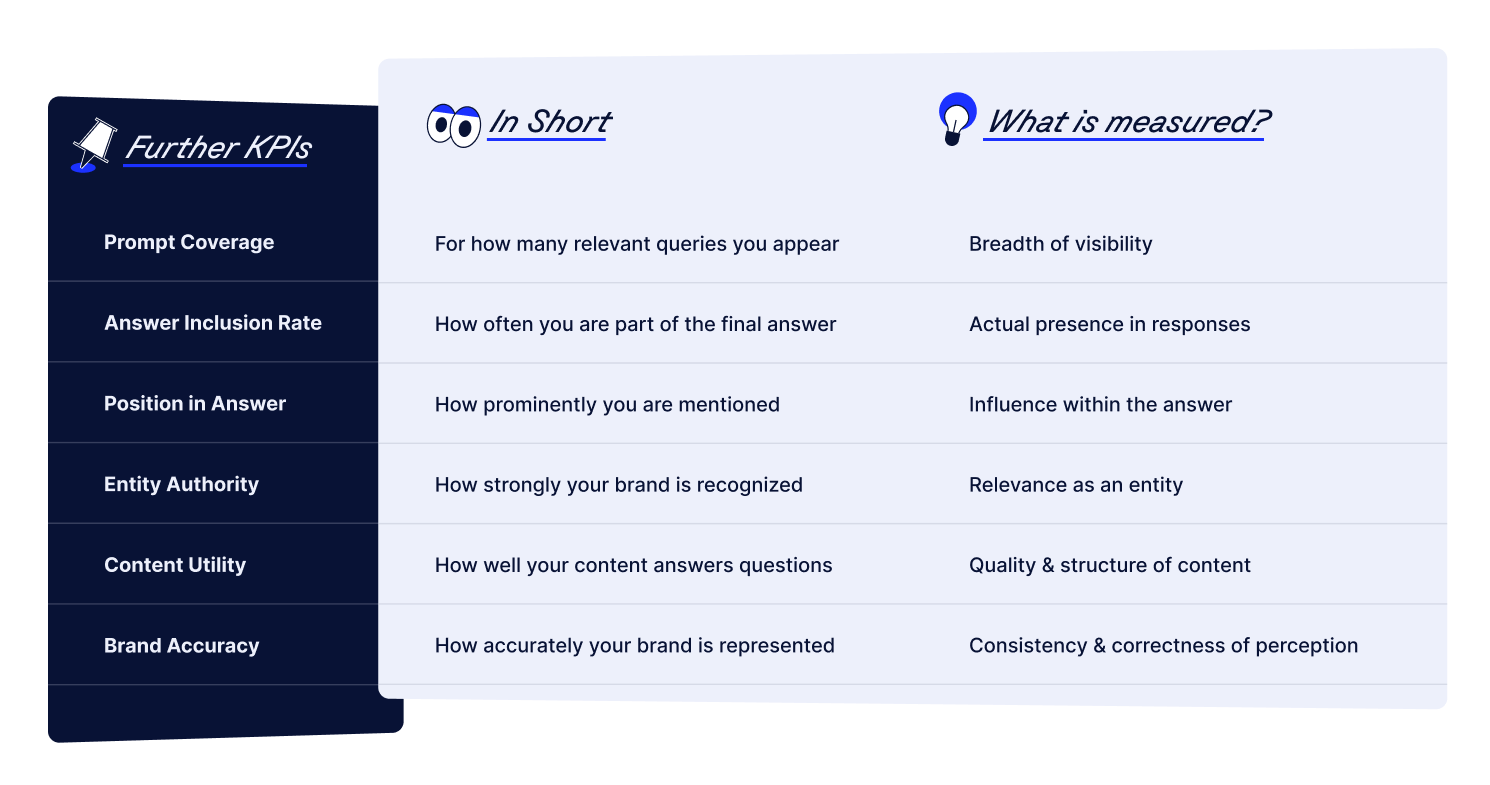
Beyond the core metrics, it’s also worth looking at additional KPIs that complete the overall picture and help evaluate AI visibility holistically.
Conclusion
AI search is changing not only how people search—but also how success is measured.
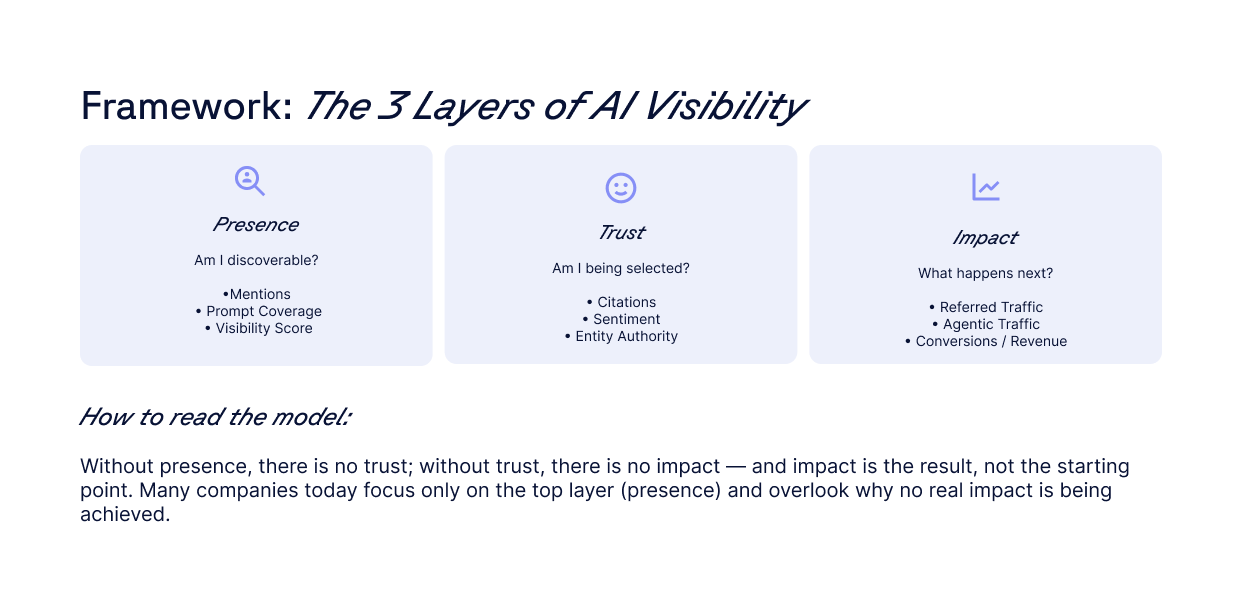
Companies need to understand three levels:
Presence (mentions, coverage)
Trust (citations, sentiment)
Impact (traffic, market share)
The key question today is:
Am I part of the answer—and if so, how visible and how positively?
Further recommendations for action on AI search can be found in our AI playbook — download it for free here.