Three Steps to the Optimal B2B Customer Journey
From Awareness to Closing: The Most Important KPIs and Best Practices – Including a Practical Checklist
In an increasingly digital B2B world, it's no longer just the product that counts - it's how you get there. This guide shows how you can use powerful product information management (PIM) and the right KPIs to optimize your customer journey based on data - from the first contact to long-term customer loyalty.
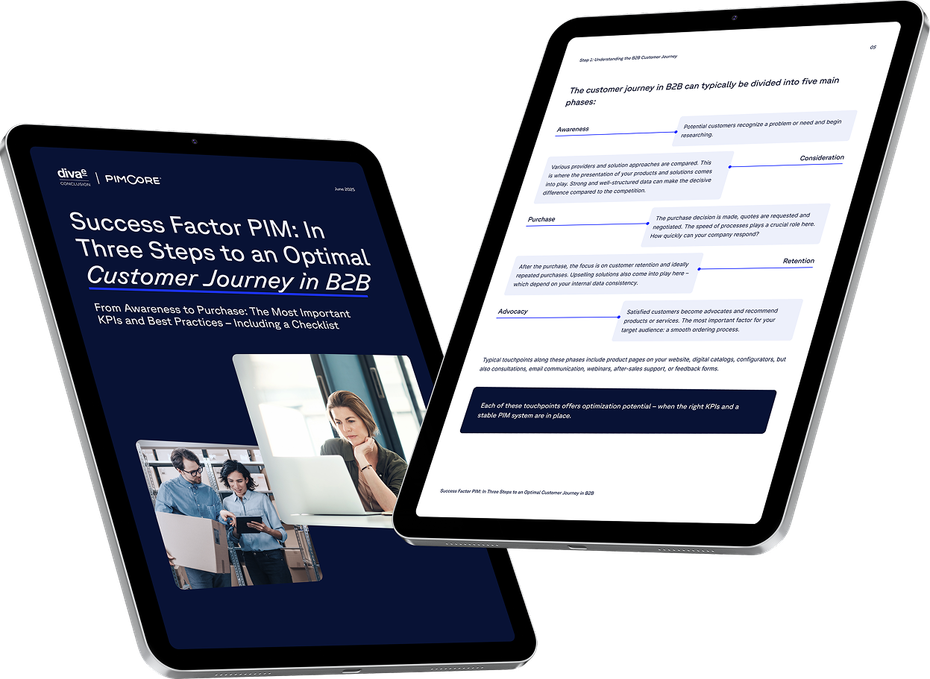
Content of the Guide
From the first interaction to customer loyalty: learn how to optimize your B2B customer journey based on data - with clear KPIs and best practices.
Current studies on customer expectations
The three most important steps to a successful B2B customer journey
Step 1: Understand the customer journey
Step 2: Define relevant KPIs
Step 3: Set up your PIM smartly
Checklist for self-assessment
Frequently Asked Questions (FAQ)
The guide explains how customer experiences can be systematically analyzed and optimized across all touchpoints. It describes how organizations can structure interactions and create consistent experiences. The focus is on strategic planning and operational implementation. The aim is to address customer needs holistically.
The guide is aimed at marketing managers, customer experience professionals, sales leaders, as well as digital and product teams. It is relevant for organizations seeking to better understand and structure customer interactions. Companies with complex customer journeys in B2B or B2C environments are particularly addressed.
A customer journey describes all phases and touchpoints a person goes through during interactions with an organization. It includes information search, purchase decisions, usage, and potential post-purchase stages. The objective is to analyze and improve these steps from the customer’s perspective.
Analysis helps identify needs, expectations, and potential friction points along the journey. Organizations can use these insights to implement targeted improvements and create consistent experiences. A structured approach supports data-driven decisions and sustainable customer relationships.
Data makes it possible to measure behavior, preferences, and interactions across the journey. It forms the basis for personalization and touchpoint optimization. An integrated data strategy across systems is required to enable meaningful insights.
Challenges often result from fragmented system landscapes, limited transparency across touchpoints, and organizational silos. Different departments influence individual stages of the journey. Holistic management requires clear responsibilities and aligned processes.
Strategic development is based on clearly defined target groups, structured journey maps, and measurable KPIs. Continuous analysis and iterative optimization are essential. Technological platforms can support consistent cross-channel experiences.
The guide is available as a PDF document. It is structured as a text-based resource providing a systematic overview of customer journey concepts. The content is suitable for independent reading and internal knowledge sharing.