From Silos to Integrated Customer Journey Management
How are Digital Marketing, Digital Commerce and digital business models evolving? The latest Lünendonk Study 2026 provides insights into the key trends, investments and challenges shaping the Digital Experience Services (DXS) market.
For the study, Lünendonk surveyed 23 leading DXS providers and 140 user companies across Germany, Austria and Switzerland. The findings show that investment in Digital Experience is increasing, while artificial intelligence is fundamentally changing how companies design and manage customer experiences.
Where investment is heading: Companies are increasing their investment in digital experience. The focus extends beyond frontends and campaigns to include operations, integration and security.
Building the right foundations for AI: High-quality data, strong governance and the right skills are essential to unlocking the full potential of AI.
The changing search landscape: Generative AI is transforming how people find information and discover brands. The study examines how companies are adapting to Generative Engine Optimization (GEO) and where they stand today.
The evolving role of service providers: DXS providers are moving beyond traditional delivery roles to become strategic integrators and orchestrators of AI-powered customer journeys.
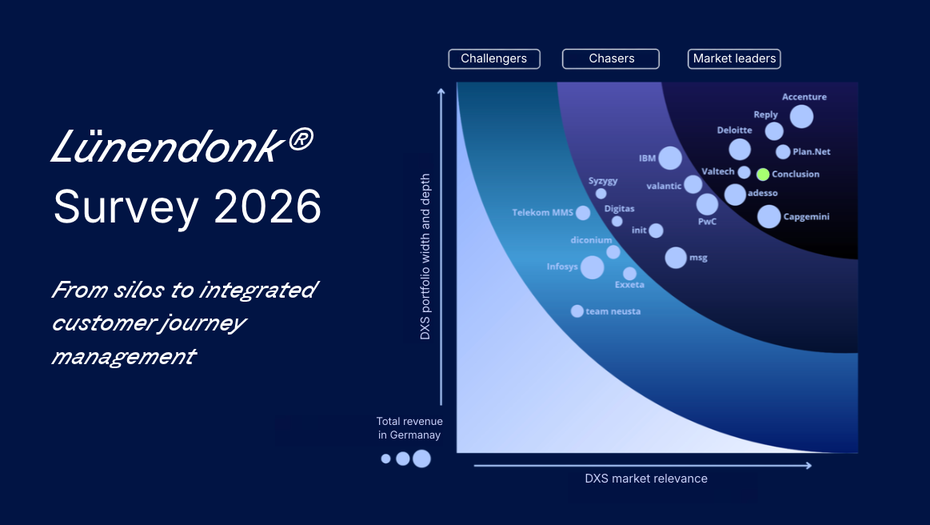
diva-e Conclusion among the market leaders
diva-e Conclusion is also featured in the study as part of the internationally operating Conclusion ecosystem, which is recognized in the market leaders category.
Frequently Asked Questions (FAQ)
The Lünendonk Study 2025 analyzes the Digital Experience Services (DXS) market in Germany, Austria, and Switzerland. It provides insights into market developments, portfolio capabilities, and key trends. The study evaluates both leading service providers and large client organizations. Core topics include revenue development, technology trends, and evolving customer requirements in the DXS sector.
The study is based on surveys of 23 leading Digital Experience Services providers and 140 client organizations in the DACH region. The research combines quantitative data with qualitative assessments. It offers structured insights into market dynamics and strategic priorities.
Digital Experience Services include all services and competencies required to design, implement, and operate holistic digital customer experiences. This covers strategy, data and analytics, UX/UI design, media production, system integration, and platform operations. The focus is on delivering consistent and high-quality digital interactions.
The study highlights technology trends through 2027, including agent-based AI solutions (Agentic AI) and multi-agent systems. It also addresses the evolution of MarTech and customer data platforms. Generative AI and marketing technologies are described as key drivers shaping the customer journey.
Generative AI is described as a major driver of innovation and efficiency in the DXS market. Organizations see significant potential in conversational AI, automated content creation, customer data analysis, and voice interfaces. Agentic AI and multi-agent systems are positioned as catalysts for further innovation.
Many organizations face challenges in orchestrating experience touchpoints across multiple systems. Integrating AI solutions into existing processes is also complex. Strategic priorities include building integrated customer journeys and developing cross-channel content strategies.
The study includes a Lünendonk ranking of leading DXS providers. It assesses companies based on market strength and portfolio capabilities. These rankings provide insight into competitive structures within the DACH Digital Experience Services market.
The study is available as a PDF document. It provides a structured, text-based analysis of the Digital Experience Services market. The content is suitable for strategic planning and internal knowledge sharing.