

Anyone researching a medical product, insurance policies, or even making a major investment in their home is increasingly less likely to start on a traditional website. Instead, many users now begin their research directly in AI systems such as ChatGPT, Gemini, or Perplexity. Answers are summarized, prioritized, and typically already include specific recommendations and brand mentions.
For businesses, this fundamentally changes digital visibility. Instead of competing for a spot among the top 10 results in Google rankings, success in AI systems often means simply being one of the two or three brands mentioned or cited in a response.
This development is particularly relevant for companies operating in so-called “Your Money or Your Life” (YMYL) sectors. Wherever information can influence financial, health-related, or safety-related decisions, search engines and AI systems evaluate content with greater scrutiny. Trust, expertise, and authority are therefore becoming increasingly decisive factors for digital visibility.
Your Money or Your Life (YMYL): Why AI Systems Evaluate Certain Industries More Strictly
Google defines “Your Money or Your Life” (YMYL) in its Search Quality Rater Guidelines as topics that can potentially impact health, financial stability, safety, or societal well-being. These include healthcare information, financial topics, legal matters, and sectors such as energy supply, infrastructure, or public services.
Accordingly, search engines and AI systems evaluate content within these areas with particular care.
Example from the Google Guidelines
An example from Google's guidelines illustrates this clearly: an informational page about seasonal influenza is considered high-quality content when it comes from a trusted and recognized medical source, demonstrates a high level of expertise, and has a proven reputation within the subject area.
Google justifies this approach by highlighting that inaccurate information in this field can have direct consequences for people's health. Therefore, such content is expected to demonstrate a particularly high level of Experience, Expertise, Authoritativeness, and Trustworthiness (E-E-A-T).
This logic is no longer limited to medical topics but applies across a wide range of industries.
The greater the potential impact of information on people's lives, the more important expertise, reputation, and trustworthiness become for digital visibility.
The Energy Industry as an Example: Why AI Search Is Becoming Especially Relevant for YMYL Businesses
Today, the energy sector is one of the industries where digital information increasingly influences financial decisions directly—a classic YMYL scenario.
Let’s look at a practical example:
Private households and businesses are currently investing billions in heat pumps, charging infrastructure, and other technologies that have significant financial implications. At the same time, funding programs, regulations, and technical requirements are constantly evolving. As a result, the need for reliable guidance continues to grow.
This is precisely where AI systems such as ChatGPT, Gemini, and Perplexity are increasingly becoming the first point of contact. More and more users rely on them for research and decision-making. They ask for specific recommendations, comparisons, and evaluations. In selecting their responses, AI systems examine cited sources particularly carefully because the decisions involved often carry substantial financial consequences.
Of course, many other industries are affected as well. In addition to the energy sector, this includes healthcare and pharmaceuticals, banking and insurance, legal services, as well as public sector and infrastructure organizations.
Wherever information influences financial, health-related, or safety-related decisions, search engines and AI systems pay close attention to the quality, expertise, and trustworthiness of the underlying sources.
The consequence of this rigorous evaluation is that not every website is treated as an equally trustworthy source. AI systems favor sources that demonstrate genuine expertise, provide transparent reasoning, incorporate real-world experience, and deliver reliable information. Brands can proactively adapt to these requirements to maintain and strengthen their visibility in AI Overviews.
How Companies in YMYL Industries Can Become Trusted AI Sources
1. Focus on New KPIs
Companies seeking greater visibility in AI systems must first understand how and where their brand is currently perceived.
While impressions are experiencing a comeback because they indicate not only how often a brand appears in Google Search but also whether it is visible in AI Overviews, new KPIs are becoming increasingly important.
In addition to brand mentions, companies should monitor citations and share of voice to evaluate their presence relative to competitors. Our article on KPIs in AI Search provides an overview of the most important metrics and their significance.
2. Continuously Optimize Content and Make Expertise Visible
Even in traditional Google Search, YMYL websites have historically been penalized when content failed to meet quality standards, often resulting in significant ranking losses. In AI systems, which frequently mention only a handful of brands, quality shortcomings can have an even greater impact on visibility.
Conversely, regularly reviewing and improving content is also positively recognized by AI Overviews. The E-E-A-T framework, which we explain in more detail in this article, remains a key benchmark. Search engines and AI systems often detect quality improvements quickly, making the optimization of existing content one of the most effective levers available.
FAQs are a particularly useful way to structure information for AI systems. This does not mean websites should suddenly consist only of FAQ sections. However, many successful pieces of content are increasingly aligned with natural user questions such as:
Which heat pump is best suited for older buildings?
How does a grid connection for solar PV systems work?
Which subsidies are currently available?
What happens during an operator change?
AI systems favor content that can answer such questions directly, clearly, and with strong subject-matter expertise.
3. Build GEO on a Strong SEO Foundation
The good news is that GEO is not entirely new. It builds on the existing SEO foundation. For AI systems, this foundation can be divided into three key pillars: 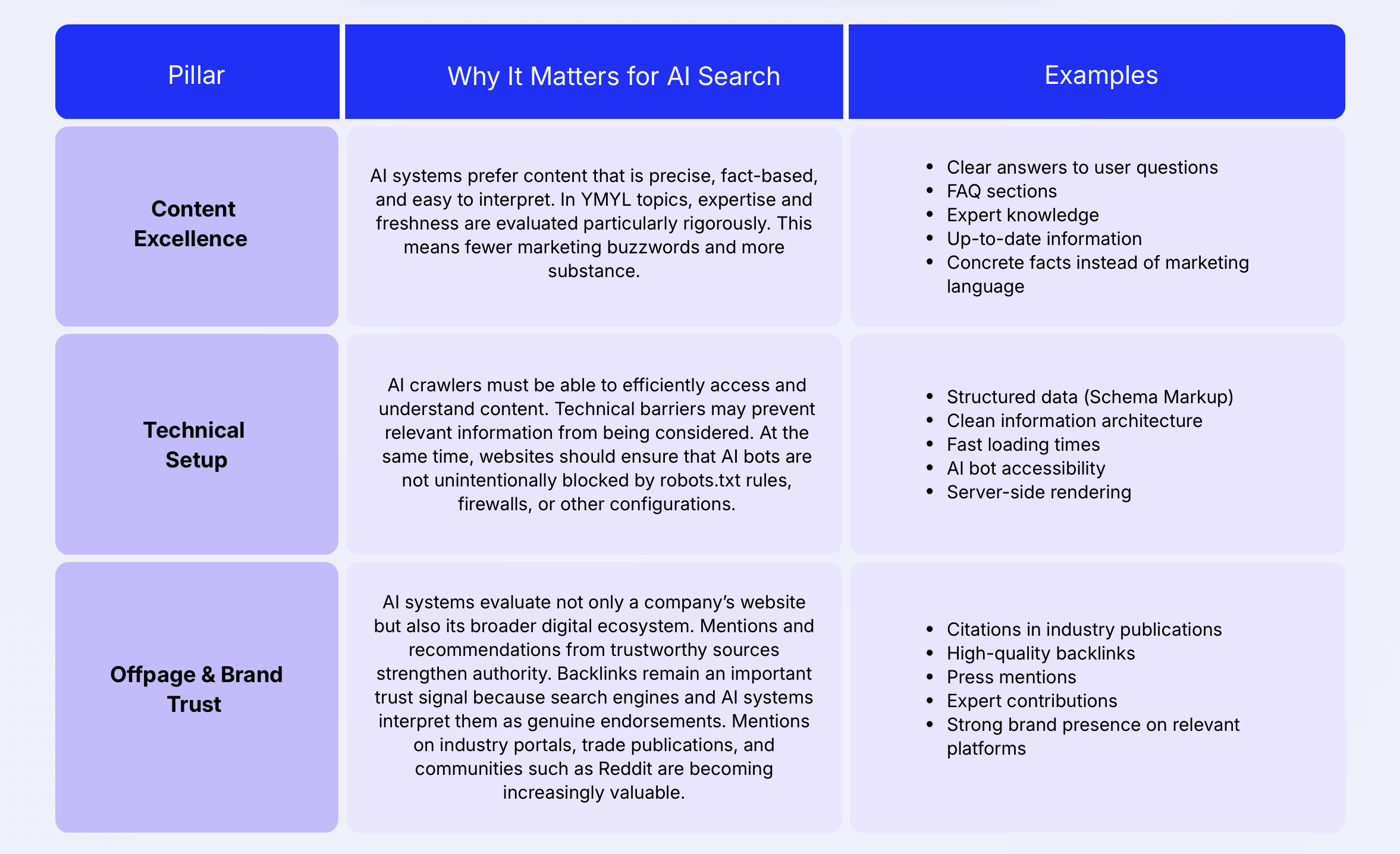
4. Break Down Silos: SEO as a Central Data Hub
As discussed above, AI systems evaluate the entire digital ecosystem surrounding a brand, including:
Corporate websites
Industry portals
Press coverage
Social media
YouTube
Communities and forums
And much more
For businesses, this means that visibility is strongest when different teams and initiatives work together. PR, social media, brand management, and SEO should therefore collaborate much more closely.
The SEO team, in particular, can play a central role. Search data, trend analysis, and user queries create a valuable pool of insights that can be leveraged far beyond the website itself. Search volume trends and emerging topics can inform PR activities, content strategies, and video production. At the same time, community analyses on platforms such as Reddit or industry forums can help identify recurring user questions, information gaps, brand perception issues, or potential misinformation at an early stage.
In short, SEO is increasingly evolving from a website channel into a strategic data hub for the entire digital communications ecosystem. Organizations that leverage these synergies improve their chances of being recognized by AI systems as relevant and trustworthy sources.
Conclusion: Trust Becomes the Currency of AI Search
The good news for many businesses is that YMYL does not reward speed or content volume—it rewards trust.
Established companies often already possess years of expertise, strong brand recognition, and substantial specialist knowledge.
The key challenge now is presenting this expertise in a way that AI systems can understand, evaluate, and prioritize.
If you would like to understand how visible your brand already is in AI Search and identify opportunities for improvement, we would be happy to support you with our GEO Audit, providing an analysis of AI visibility, competitive positioning, and concrete optimization recommendations.