

Websites, apps, CRM systems, newsletters, online shops, customer service, and offline touchpoints generate valuable customer data every day. However, in many organizations, this information is scattered across different systems. As a result, marketing, sales, and service teams often have only a limited view of the entire customer journey. This has noticeable consequences in practice: Campaigns often require a significant amount of manual preparation, teams work on similar activities in parallel, and targeting and personalization fall short of expectations. At the same time, the requirements for data privacy and data quality continue to increase.
A Customer Data Platform (CDP) can help address these challenges. It brings together customer data from different sources, connects interactions into consistent customer profiles, and makes audiences and events available to downstream systems and channels. This creates the most consistent 360° view of customers possible.
However, this is exactly where a brief reality check is worthwhile: A CDP can accomplish a lot. But it is not a self-running solution – and certainly not a magic cure for unresolved data or organizational issues. The selection process should therefore not begin with the question: “Which platform offers the most features?”
A CDP is not simply another marketing tool. It changes how organizations organize customer data, make it accessible across departments, and translate it into meaningful interactions. Choosing a CDP is therefore a strategic transformation decision. When approached correctly, it can lay the foundation for reliable data utilization, better customer experiences, and sustainable processes in the long term.
In this article, we explain the ten criteria that really matter when selecting a CDP.
What Is a CDP and Who Is It Relevant For?
A Customer Data Platform brings together data from different sources, consolidates it into customer profiles, and makes it available for analysis, segmentation, and activation.
Typical data sources include:
CRM systems
Web and app tracking
E-commerce platforms
Marketing automation systems
Customer service and contact center solutions
ERP and transaction systems
Offline touchpoints such as points of sale or branches
Data warehouses and business intelligence systems
Newsletter and campaign platforms
A CDP is only as reliable as the underlying data, identifiers, matching rules, and consent allow. This highlights the importance of having a clear data strategy as the starting point for selecting and implementing a CDP.
A CDP is particularly relevant for companies that:
operate many digital and offline customer touchpoints (e.g., web, app, CRM, POS, etc.),
have a growing and complex data landscape,
offer long sales cycles or products that require explanation,
engage with customers across many touchpoints,
want to expand personalization and data-driven growth.
Company size alone is not the decisive factor. Whether a company is a mid-sized business or an enterprise, what matters most is the number and complexity of customer interactions, the requirements for personalization, and the ability to make data usable across departments.
Why Choosing a CDP Affects the Entire Organization
For the purposes of this article, the key tasks of a CDP can be divided into three central areas:
Data: Unifying fragmented customer data, creating a single customer view, and integrating different data sources
Analysis and Decision-Making: Segmentation, analytics, next best offer, and deriving relevant audiences
Activation: Audience building, personalization, campaign activation, and delivery across different channels
What becomes clear here is that the responsibilities associated with these areas generally span multiple teams. The selection process should therefore not be handled in isolation by a single department. Marketing, sales, customer service, IT, data teams, and legal may have different requirements for a CDP.
The success of a CDP project therefore depends not only on the technology, but above all on a shared understanding of which processes should be improved and which goals should be achieved.
The 10 Most Important Criteria for Choosing a CDP
1. Define Business Goals and Specific Use Cases First
Many CDP projects start with technology-related questions: Which platform can integrate particularly large numbers of data sources? Which solution offers the latest AI capabilities? Which vendors are well known in the market?
A more effective starting point is to ask: What specific business problem should the CDP solve for us? It is worth taking a use-case-based approach and documenting these use cases systematically. Which use cases are relevant depends on the individual company and its organizational structure.
Possible use cases include:
Building an audience for a personalized campaign
Personalizing website or app content
Next best offer for defined customer segments
Activating audiences in email, CRM, or advertising channels
Combining online and offline interactions
Improving the handover of relevant information between marketing, sales, and service
Segmenting leads throughout a long sales cycle
From Project Experience: One of the most common mistakes when selecting a CDP happens at precisely this stage. Companies adopt a CDP as the solution before clearly defining the actual problem and developing a clear data strategy.
Without prioritized use cases, there is a risk of taking a tool-first approach. Companies may then invest in a platform without knowing which data, processes, and responsibilities are required to generate tangible value.
2. Assess Data Sources, Data Quality, and Data Availability
A CDP can bring fragmented data together. However, it cannot automatically turn missing, outdated, or inconsistent information into high-quality customer data.
Before selecting a platform, companies should therefore conduct an assessment:
Which data sources are available?
What data is stored in each of them?
How current and complete is the data?
Which data may be used for which purposes?
How are changes and deletions processed?
Which data is available in real time and which is only available with a delay?
Who is responsible for the quality of the respective data?
The interfaces to the following systems are particularly relevant:
CRM, web, and app tracking
E-commerce
Marketing automation
Customer service
Data from offline touchpoints can also be important when companies want to build an omnichannel view of the customer journey. Selecting a CDP is therefore always also a decision about data processes.
Companies should realistically assess how much effort will be required for data cleansing, mapping, validation, and ongoing quality assurance.
Important: A data strategy is not a one-time cleanup project before go-live. New sources are added, existing systems change, and requirements regarding data and consent continue to evolve. Responsibilities and routines for ongoing quality assurance should therefore be planned from the outset.
3. Evaluate Identity Resolution and Profile Unification
When selecting a CDP, you should assess how reliably the solution can consolidate customer profiles from different data sources – a process also known as identity resolution.
An example: A person initially visits a website anonymously, later signs up for a newsletter, subsequently uses the app, and eventually makes a purchase in the online store. Under defined conditions, a powerful CDP can assign these interactions to a single profile.
When evaluating solutions, companies should consider the following, among other factors:
Which data sources and customer data are taken into account?
How transparent and traceable is the profile unification process?
How are different or incomplete data handled?
Is the solution suitable for our relevant customer and business models?
Note: Especially in B2B environments, focusing solely on individuals is often not sufficient. Contacts may belong to companies, business units, or locations. The data model must be able to represent these relationships without becoming unnecessarily complex.
4. Consider Integration and Activation Capabilities
A CDP creates value through its integrations with the systems from which it collects, processes, and, where applicable, returns data.
Companies should therefore ask the following questions when selecting a solution:
Which standard connectors are available?
Which APIs and export options are provided?
How are batch and real-time data processed?
Can CRM, marketing automation, e-commerce, web, app, and advertising systems be connected?
How easily can new systems and channels be added?
Is the platform flexible enough to support future use cases and additional channels?
It is equally important to determine whether the CDP only passes audiences to other systems or also supports the delivery and coordination of customer interactions.
An open, API-first, and cloud-native architecture can offer significant advantages: It facilitates integration into the existing system landscape and provides flexibility for new systems, channels, and future use cases.
5. Assess Real-Time Capabilities and Scalability in Detail
Real-time capabilities are an important technical selection criterion. Companies should assess how quickly a CDP can process data from different sources, update customer profiles, and make relevant audiences available for personalized activities.
The actual requirements depend on the respective use case. For some organizations, regular updates are sufficient; for others, the ability to respond as quickly as possible is critical.
A CDP should also scale with the company and its requirements. Companies should pay particular attention to increasing data volumes, real-time personalization across multiple channels, new data sources, and additional markets. Flexible data models and an extensible architecture provide the necessary foundation.
6. Ensure Data Privacy, Consent, and Data Governance
Personalization, segmentation, and campaign activation are among the key areas of application for a CDP. At the same time, they bring increased requirements for data privacy, security, and governance.
Legal, data privacy, and the relevant business teams should therefore be involved early in the use-case and vendor evaluation process.
Ask yourself the following questions:
How is data privacy implemented in the solution?
Which security and compliance features does the platform provide?
How are data quality and data availability ensured?
Which responsibilities and roles exist for using and maintaining customer data?
How can data and processes be governed across different markets and business units?
A centralized data foundation does not automatically improve governance. Clear responsibilities, coordinated processes, and a shared understanding of how customer data is used across the organization are also required.
7. Assess Usability and Organizational Requirements
A CDP is a comprehensive transformation project because its implementation affects multiple areas of the organization:
IT connects data sources and ensures technical operations.
Marketing and sales want to build audiences, personalize campaigns, and leverage relevant customer signals.
Customer service benefits from a more comprehensive view of customers.
To bring all these perspectives together, responsibilities should be clarified at an early stage:
Who is responsible for the CDP overall?
Who prioritizes new use cases?
And who coordinates decisions regarding data privacy and governance?
The implementation of a new CDP also involves additional coordination and adaptation efforts – for example, when data sources need to be reviewed, processes adjusted, or teams prepared for new ways of working. This effort should be planned from the outset.
The platform itself should also be suited to its future users. If business teams have to rely on IT for every minor change, the CDP can quickly become a bottleneck.
Practical Tip: Do not try to map all data sources and channels immediately. Instead, choose a specific use case with clear value, involve the relevant teams early, and use initial quick wins to build acceptance for the next steps.
8. Assess AI Capabilities and Future Use Cases Realistically
Many CDP vendors currently promote AI-powered segmentation, predictions, and recommendations. These capabilities can quickly appear to be the next major lever for growth. However, such features should not be considered in isolation when evaluating vendors.
As with all other CDP capabilities: First determine which specific use case you want to address with the respective feature and what measurable contribution AI can make to your organization.
9. Assess Implementation Effort and Partner Expertise
Implementing a CDP is complex – and this is frequently underestimated during the selection process. Even reproducing a single real-world use case in a proof of concept (PoC) can require significant time.
The actual effort depends heavily on the existing system landscape, data quality, the number of sources and channels, and the complexity of the use cases. Companies should always critically evaluate blanket promises of a fast, out-of-the-box implementation.
Tip: Ask the vendor specifically which services are included as standard, where custom development will be required, and which internal resources you will need to allocate.
An experienced implementation partner can make an important contribution to the successful introduction of a CDP. They can help plan use cases realistically, develop data models and integrations, and gradually transition the solution into day-to-day operations. We support you holistically – from strategic questions around architecture, governance, and change to implementation and the continuous development of your CDP.
10. Consider TCO and Investment Security
As with other major platform projects, licensing costs account for only part of the total cost of a CDP. For a realistic assessment, companies should always consider the Total Cost of Ownership (TCO) over several years.
This includes, among other things:
License or subscription costs
Pricing based on profiles, events, data volume, or activations
Costs for additional modules and target channels
Implementation and integration
Data cleansing and migration
Development of custom extensions
Operations, monitoring, and support
Training and enablement
Ongoing data and process maintenance
Development of additional use cases
Important to Know: A CDP is rarely “finished” after go-live. It is generally continuously developed with new data sources, channels, and use cases. Companies should take this perspective into account when selecting and budgeting for a platform.
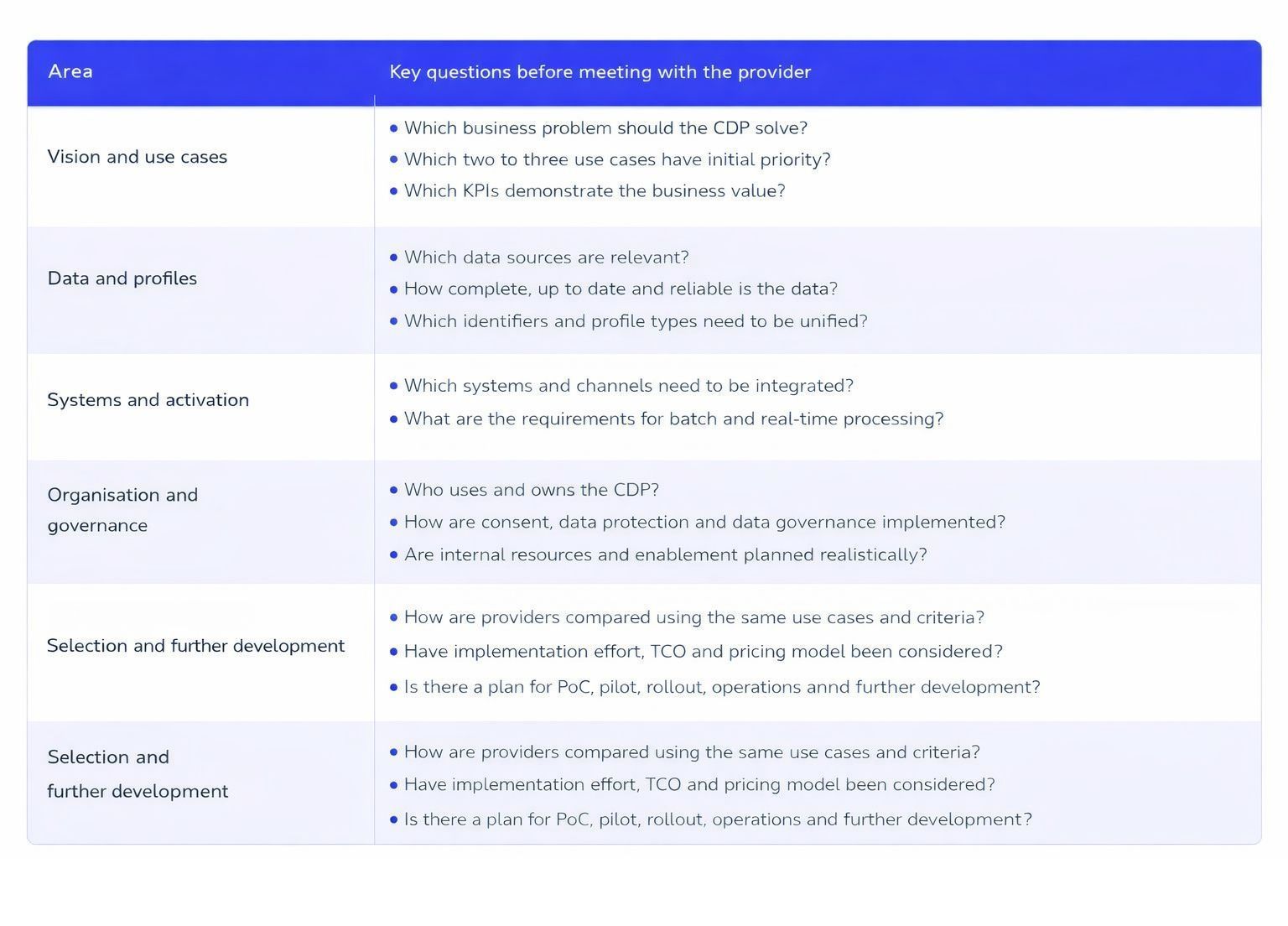
Checklist: What You Should Clarify Before Choosing a CDP
We have explained the most important CDP selection criteria in detail in the previous sections. The following overview provides a checklist of the questions companies should ask themselves before their first vendor meeting:
Conclusion: The Right CDP Starts with Clear Use Cases and a Data Strategy
A Customer Data Platform can bring fragmented customer data together, improve personalization, and support collaboration between marketing, sales, service, and IT. However, value only emerges when there are concrete use cases and clear business objectives.
A clear data strategy is a critical starting point. It defines which customer data is relevant to the organization, how this data is used, and which objectives can be achieved with it. Only on this basis can companies meaningfully assess the requirements they have for a CDP.
Organizations that skip these fundamentals and, for example, only compare feature lists risk selecting a platform without being able to properly assess its future value and the prerequisites required for success.
Get to Your CDP in 3 Steps
With our structured approach, we ensure that the selected CDP fits your business processes perfectly:
Discovery Workshop: Free analysis of your current IT landscape and requirements.
Use Case Development: Identification and prioritization of relevant use cases.
Solution Evaluation: Selection of the right CDP based on your specific requirements.
Are you considering selecting a Customer Data Platform or looking to further develop your existing CDP landscape? Our CDP solutions integrate seamlessly into your existing IT infrastructure and provide a 360° customer view, real-time data processing, automated segmentation, and predictive analytics.