

A Customer Relationship Management (CRM) system is far more than a digital contact database. It serves as the foundation for efficient sales processes, personalized marketing campaigns, and consistent customer service. At the same time, it provides the data needed for informed business decisions and a seamless customer experience.
Yet many CRM initiatives fail—not because of the technology itself, but because organizations select the wrong solution. Too often, companies focus on feature lists while overlooking business processes, user requirements, and the existing IT landscape. The result is costly customizations, low user adoption, and unnecessary long-term expenses.
The real question is therefore not: "Which CRM is the best?" Instead, ask: "Which CRM is the best fit for our business—today and in the future?"
A structured selection process helps answer this question objectively. In this guide, we explain the proven steps organizations should follow and the key criteria to consider when evaluating CRM solutions.
Choosing a CRM: A Structured Process Instead of Gut Feeling
Selecting a CRM should never be based solely on impressive product demonstrations or market popularity. A strategic evaluation begins much earlier—with a thorough understanding of your own business requirements.
Most organizations use a CRM platform for many years. Therefore, the evaluation should not only address today's challenges but also future developments such as international expansion, new business models, increasing automation, and AI-driven processes.
A structured CRM selection process can be divided into eight sequential steps.
1. Define Business Goals and Requirements
Before comparing software vendors, you need a clear understanding of what your CRM should accomplish.
Many companies begin with a list of desired features. A far more effective approach is to start by analyzing the business processes the CRM should support.
Ask questions such as:
What challenges do we face today?
Which processes involve the most manual effort?
Where are leads or customer information getting lost?
Which KPIs should improve?
Which departments will use the CRM?
Typical objectives include:
Increasing sales conversion rates
Improving lead management
Strengthening collaboration between marketing and sales
Accelerating customer service response times
Creating a unified 360-degree customer view
Delivering more meaningful reports and sales forecasts
Only after these goals are clearly defined can requirements be prioritized and vendors compared objectively.
Best Practice Tip: Conduct workshops with all relevant business units. Sales, marketing, customer service, and IT each have a different perspective on customer processes. Involving all stakeholders early significantly reduces the risk of costly adjustments later in the project.
2. Involve Stakeholders Early
A CRM rarely affects only one department. Modern CRM platforms connect marketing, sales, customer service, commerce, and often finance and product management. As a result, each department brings different priorities and expectations.
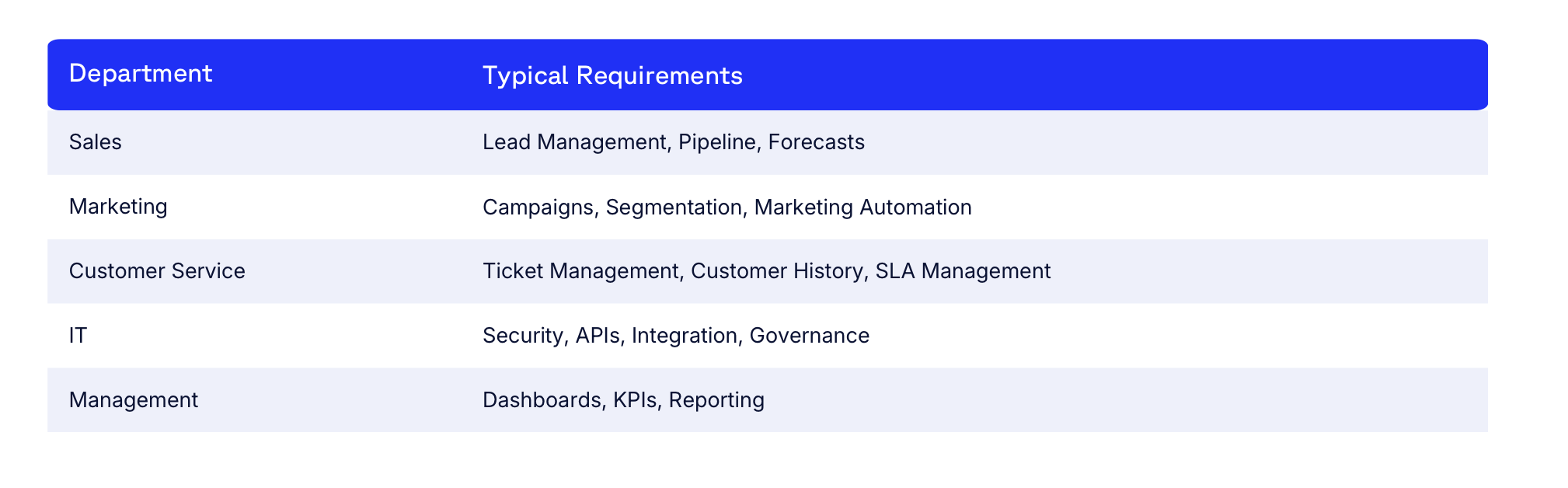
If these requirements emerge only during implementation, project complexity and costs often increase significantly.
A collaborative requirements management process creates transparency while ensuring broad organizational buy-in.
3. Prioritize Requirements: Must-Have vs. Nice-to-Have
Once requirements have been collected, the next step is prioritization.
Remember:
A CRM project's success is rarely determined by individual features alone. Many organizations compare hundreds of features, although only a small percentage are truly business-critical.
A proven approach is to classify requirements into Must-Have and Nice-to-Have categories. This prioritization not only simplifies vendor comparison but also helps avoid unnecessary custom development. Another important consideration is distinguishing between standard functionality and company-specific requirements.
Instead of replicating every existing process, organizations should evaluate whether current workflows can be improved. Modern CRM platforms already include many best-practice processes, enabling companies to benefit from standardized, scalable workflows.
Best Practice Tip:
Define your evaluation criteria before attending the first product demonstration.
This prevents individual features from disproportionately influencing the overall assessment.
4. Compare CRM Vendors Systematically
Once your business requirements have been clearly defined, the actual software evaluation can begin.
However, the focus should extend beyond functionality alone. Equally important are factors such as scalability, integration capabilities, ease of use, and the vendor's long- term product strategy.
A structured evaluation framework helps compare CRM platforms objectively.
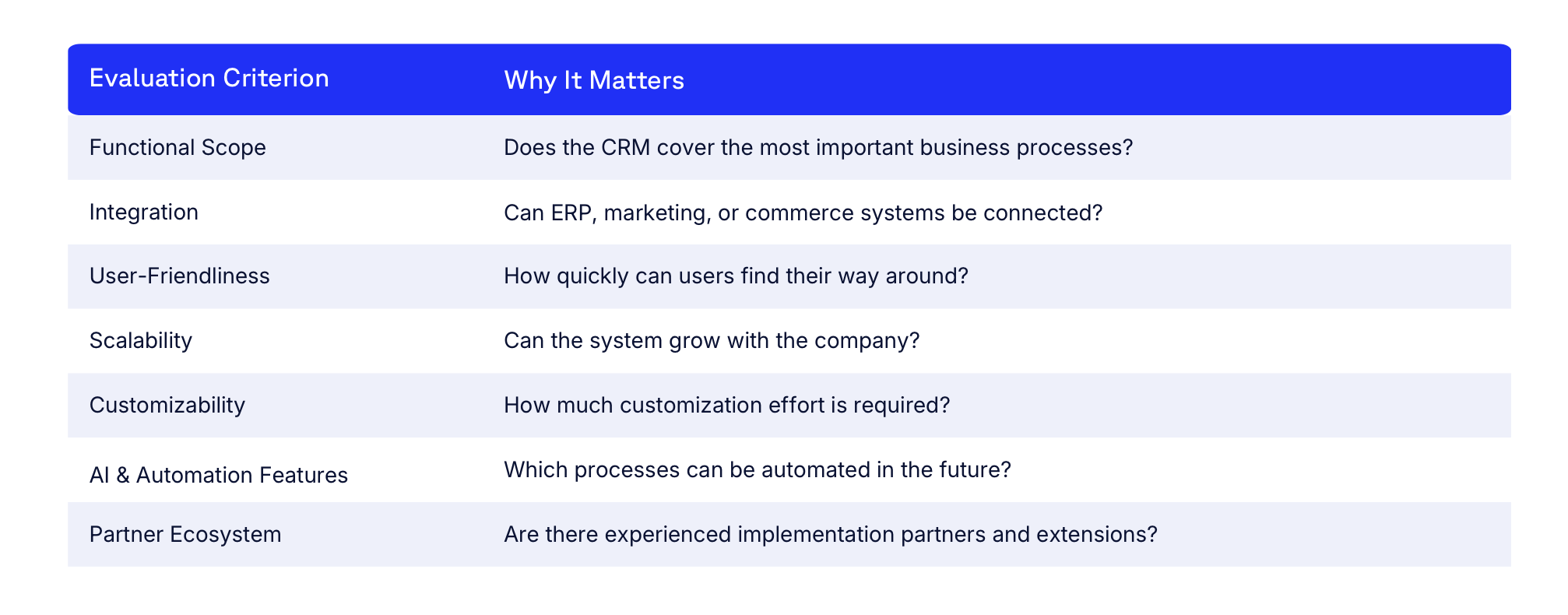
Cloud-based CRM platforms evolve continuously. Therefore, organizations should also evaluate the vendor's product roadmap.
Future investments in artificial intelligence, automation, analytics, and omnichannel customer experience may become decisive competitive advantages over the coming years.
5. Demos and Proof of Concept: Testing the CRM in Practice
Once you've shortlisted potential CRM solutions, the most critical phase begins.
Product demonstrations provide a useful first impression—but they cannot replace real-world testing.
Instead of accepting a generic product presentation, ask vendors to demonstrate their platform using your own business scenarios.
A Proof of Concept (PoC) or interactive workshop allows your team to validate how well the solution supports everyday operations.
Typical scenarios include:
Managing a lead from first contact through closing
Executing a marketing campaign
Handing over a customer from Sales to Customer Service
Creating dashboards and management reports
Integrating the CRM with existing business systems
The more realistic the scenarios, the easier it becomes to evaluate whether the platform truly fits your business.
Key users from Sales, Marketing, Customer Service, and IT should actively participate in these sessions. Their feedback provides valuable insights into usability, process efficiency, and user acceptance.
Evaluate Vendors with a Scorecard
To compare vendors objectively, use a structured evaluation matrix.
A scorecard increases transparency and prevents decisions from being driven primarily by subjective impressions.
Example:
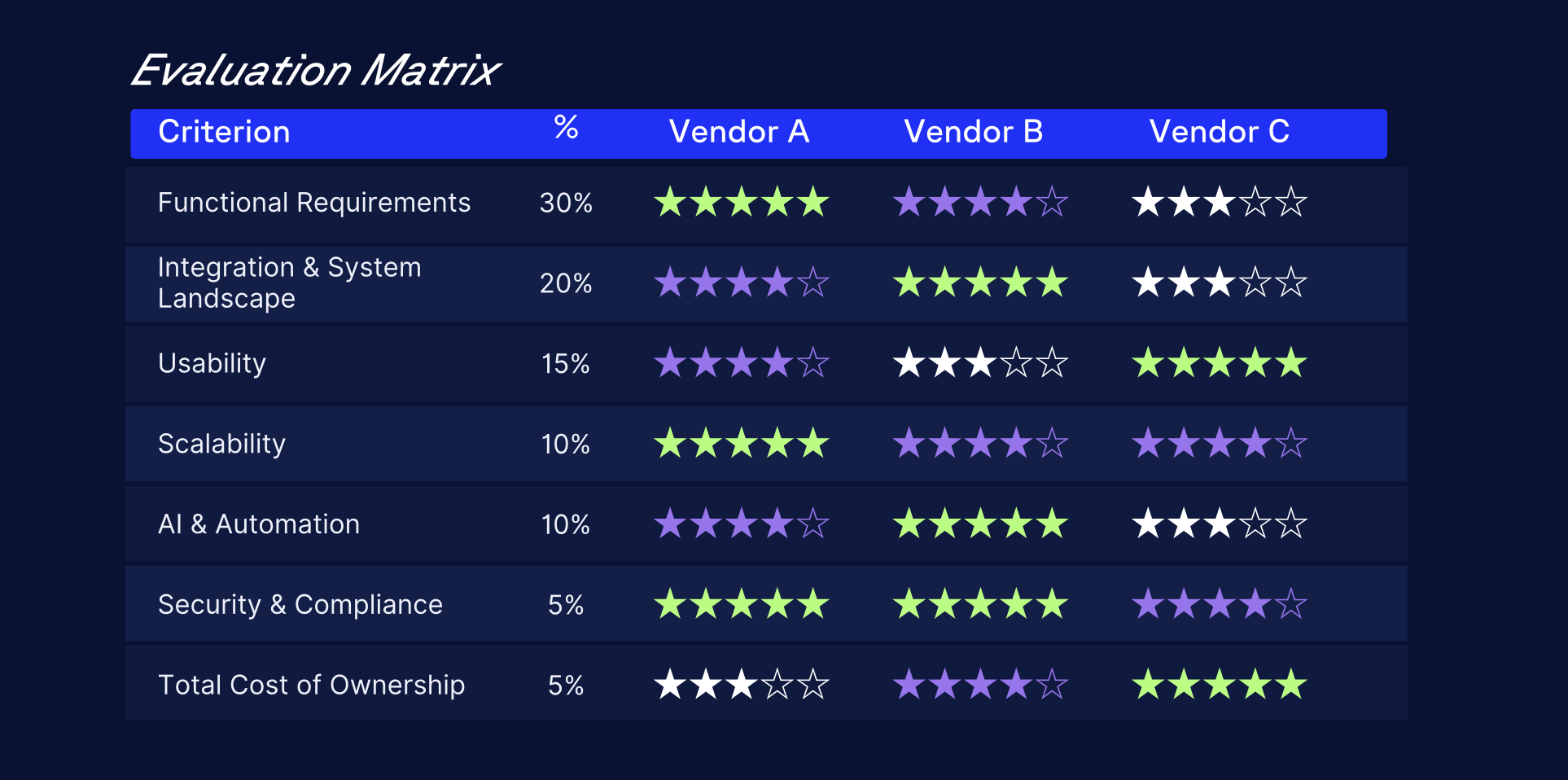
Evaluation criteria may include:
Functional fit
User experience
Integration capabilities
Flexibility
AI capabilities
Total cost of ownership
Vendor strategy
Implementation effort
Support and partner ecosystem
Each criterion can be weighted according to its importance and scored consistently across all vendors.
6. Evaluate Total Cost of Ownership (TCO)
Software licensing is only one component of the overall investment. A CRM project typically generates additional costs throughout its lifecycle that should already be considered during vendor selection.
Key cost factors include:
Software licenses
Implementation services
Data migration
Integration development
Customization
User training
Operations and maintenance
Technical support
Continuous platform enhancements
Organizations that focus solely on the lowest subscription fee often face significantly higher long-term costs.
Instead, evaluate the Total Cost of Ownership (TCO) over several years.
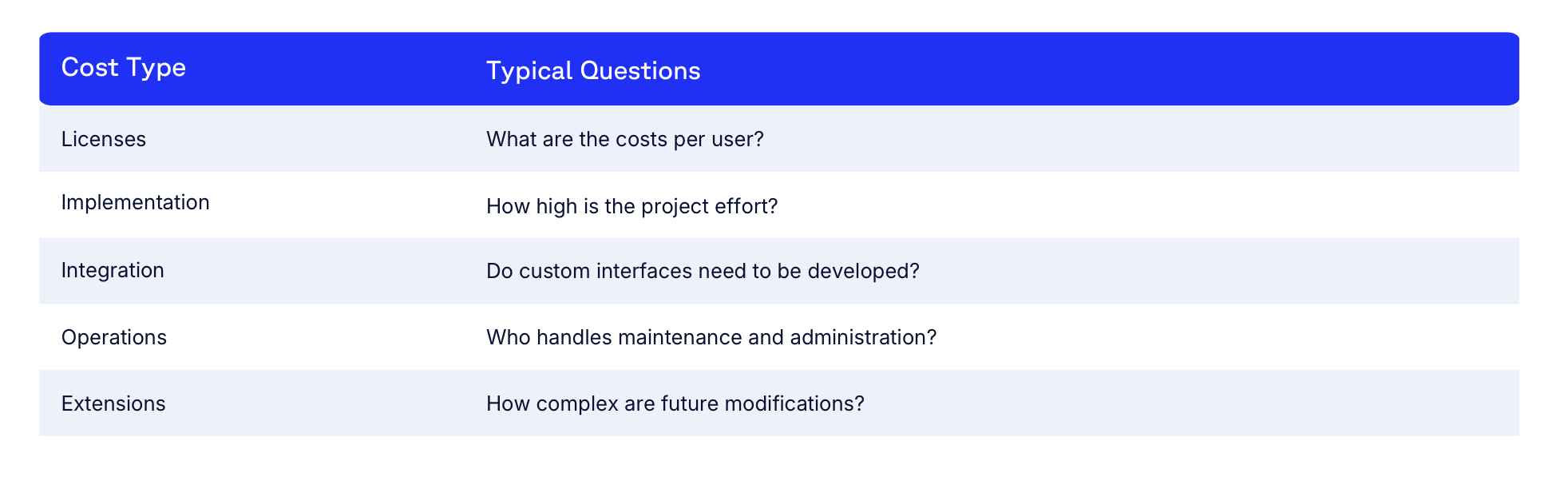
A realistic financial comparison always considers the complete lifecycle of the CRM platform—not only its initial purchase price.
7. Consider Implementation from the Start
Choosing the right CRM is only the first step. Long-term success depends on how effectively the platform is introduced across the organization.
Even the most powerful CRM delivers little value if employees do not adopt it or if business processes remain inconsistent.
During the selection phase, organizations should already define their implementation strategy by answering questions such as:
How will existing customer data be migrated?
Which business processes should be standardized?
How will employees be trained?
Who will own and govern the CRM platform?
How will the solution evolve over time?
Data quality is equally critical.
Duplicate, incomplete, or outdated customer information reduces the effectiveness of reporting, automation, AI capabilities, and daily operations.
A structured implementation plan establishes the right foundation, supports user adoption, and enables long-term success.
8. Choose the Right Implementation Partner
Most organizations possess deep expertise within their own industry but have limited experience with CRM transformation projects.
An experienced implementation partner can therefore provide valuable support—not only during deployment but already during the selection process.
Typical areas of support include:
Business process analysis
Requirements prioritization
Objective vendor evaluation
Integration architecture
Data migration planning
CRM strategy development
Change management
Long-term optimization and support
Working with an experienced partner helps reduce project risks, accelerate implementation, and maximize the return on investment.
CRM Selection Checklist
Before making your final decision, you should be able to answer "Yes" to the following questions:
✔ Are your business objectives clearly defined?
✔ Have all relevant departments been involved?
✔ Have Must-Have and Nice-to-Have requirements been prioritized?
✔ Have multiple CRM vendors been evaluated using identical criteria?
✔ Have realistic business use cases been tested?
✔ Have integrations with existing systems been verified?
✔ Have you evaluated the Total Cost of Ownership (TCO)?
✔ Is there a clear implementation, training, and change management plan?
✔ Can the platform support future growth and evolving business models?
The more questions you can answer with Yes, the lower the risk of making an expensive long-term mistake.
Conclusion
Choosing a CRM is far more than a software purchasing decision. It determines how effectively Sales, Marketing, and Customer Service collaborate and how consistently customers experience your brand across every touchpoint.
A structured selection process helps organizations identify the CRM that best supports their business goals—not necessarily the platform with the most features. Companies that define requirements early, involve stakeholders throughout the process, and consider long-term impacts on processes, data, and organizational change create the strongest foundation for a successful CRM implementation.
Planning to implement a new CRM or modernize your existing CRM landscape? Our experts help you define requirements, evaluate leading CRM platforms, and develop a CRM strategy tailored to your business—from selection and implementation to continuous optimization.