

Be honest for a moment. If you had to defend your last major platform decision today, in front of your board, your ops leaders, and your digital teams, how confident would you be? Not in the demo. Not in the feature list. In the decision itself.
Most enterprise technology decisions are still made backwards: a tool gets picked, the first MVP takes over 6 month, then someone retrofits a business case. A roadmap is drawn, then reality rewrites it. That pattern used to be survivable. When markets moved slowly, when buyer expectations were stable, and when technology cycles lasted a decade, you could afford to pick a platform first and figure out the strategy later. In today's environment, that approach is becoming dangerous. The cost of a wrong platform decision has gone up. The time to correct one has gone down. And the number of variables you need to get right has multiplied.
This post is the starting point of a series about how to make better platform decisions. Not by buying better tools, but by designing better architecture.
Four things most platform strategies get wrong:
1. Choosing a Tool Is Not a Digital Strategy
Tools feel concrete. Architecture feels abstract. That's why tools win procurement battles, and architecture wins or loses transformations. But most of the tools you rely on today will not be the tools you rely on in five years. Possibly not even the same software categories.
AI-native platforms are already redefining established ones. Agentic systems are starting to blur the line between application, integration, and automation. Categories that didn't exist two years ago are now on vendor shortlists. Categories that dominate today may be absorbed, unbundled, or replaced by something that doesn't have a name yet. Consider how fast this is moving.
Example: Two years ago, "agentic commerce" was not a term anyone used. Today, multiple vendors are positioning agentic capabilities as core differentiators.
This also means: Two years from now, the distinction between a commerce platform, an integration layer, and an autonomous process engine may no longer be meaningful. If your architecture cannot absorb that kind of shift, you are not future-proof. Most platform decisions collapse these layers into a single vendor bet. That's where the risk lives.
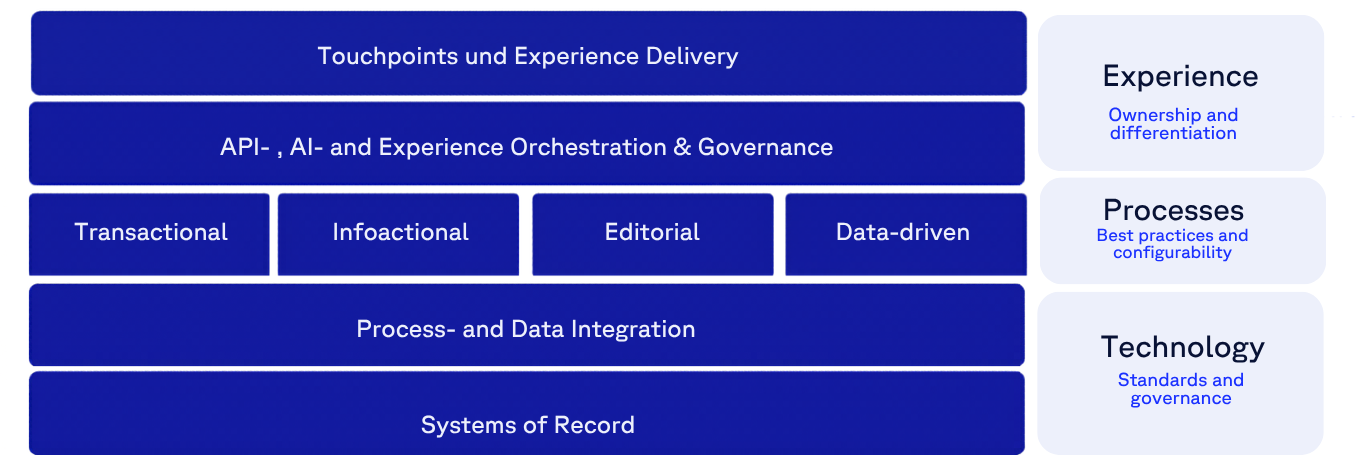
If your platform decision hard-codes assumptions about specific vendors, rigid process flows, or tightly coupled system landscapes, you are locking tomorrow's business into yesterday's thinking. Architecture is what gives you optionality. Architecture is what allows replacement without reinvention. Architecture is what turns change from a threat into a capability.
The practical test is straightforward: could you replace a major component of your current stack within twelve months, without rewriting your business logic, without disrupting your customer-facing channels, and without a seven-figure re-implementation budget? If the answer is no, your architecture is not serving you. It is constraining you.
2. Your Buyers Have Changed Faster Than Your Platform Strategy
Even in B2B manufacturing, the buyer demographic has shifted. Not gradually but dramatically. Over 60 percent of B2B decision-makers today are Gen Z or younger millennials. They don't wait for your sales team. They research independently, compare relentlessly, and filter ruthlessly. And here's the part most platform strategies haven't caught up with: close to 90 percent are already using AI-assisted research as their default mode of evaluating vendors, products, and partners.
Think about what that means in practice. A procurement lead at an industrial manufacturer no longer starts with a call to your sales rep. They start with a prompt. They ask an AI assistant to compare suppliers, evaluate technical specs, assess delivery reliability, and rank options against weighted criteria. Your beautifully designed website, your carefully crafted brand messaging, your glossy PDF brochures: none of that matters if the underlying data is not structured in a way that machines can read, interpret, and act on.
That changes the game fundamentally: Your platform is no longer competing only for human attention. It is competing for machine interpretability, composability, and actionability. If your offering is not machine-readable, not API-first, not agent-friendly, and not designed for AI-assisted discovery, it will simply not show up where future decisions are made. Not because it's bad. Because it's invisible. It’s way more than a cosmetic update to your digital presence. How your systems expose information, how your APIs serve data, and how your content architecture supports machine consumption alongside human consumption is a structural decision. It is architecture. And most platform strategies haven't even started thinking about this.
3. Customer Experience Alone Is Not a Business Model
Many platform decisions still start and end with "customer experience." That's not enough.
Great customer experience without an aligned operating model is expensive theatre. It looks impressive on the surface. It demos well. It wins internal buy-in. But it collapses the moment it meets operational reality. This is especially true in manufacturing, where the real complexity sits behind the storefront:
configure-to-order logic
contract-based pricing
multi-warehouse fulfillment
dealer and distributor channel conflicts
ERP-driven availability checks
after-sales service workflows that no frontend redesign will fix.
A manufacturer who invests millions in a beautiful self-service portal but can't deliver accurate pricing in real time, can't reflect true inventory across warehouses, or can't handle the contractual nuances of a long-standing distributor relationship has not modernized. They have built a digital camouflage.
The questions that get missed far too often:
How does this platform change the way you sell, service, and operate?
Which processes become simpler, and which become more complex?
Where does automation actually happen, and where does human work remain essential?
What does this do to cost structures, margins, and scalability?
And critically: does your operating model support the experience you are promising?
Business-led enterprise architecture forces these questions early. It connects business outcomes to capabilities, and capabilities to systems that can support them. It starts with the outcome you need to produce, translates it into a target architecture that survives contact with reality, and only then evaluates vendors. The sequence matters. When you reverse it, when the vendor evaluation comes first and the architecture follows, you end up fitting your business to the tool instead of fitting the tool to your business.
4. Own What Matters
Not everything needs to be owned. But some things absolutely do.
Systems of record. If your core data (products, customers, pricing, contracts) is not truly mastered by you, differentiation is impossible. You can't out-compete on product data quality, pricing flexibility, or contract terms if someone else's data model dictates what's possible. It is a pattern we see repeatedly: companies that have handed their product data mastery to a commerce platform, their pricing logic to an ERP module they don't fully control, or their customer data to a CRM that was configured five years ago and never revisited. Every one of those decisions limits what you can do next.
Customer experience. If your customer experience is shaped by vendor constraints rather than architectural intent, you are renting your differentiation. And what you rent, your competitor can rent too, from the same vendor, on the same terms. The experience layer is where your brand becomes tangible, where your value proposition takes shape, where your customers decide whether you are a commodity or a partner. That layer must be yours to design, control, and evolve.
No client has ever chosen you because of the CMS you use. They choose you because of speed, reliability, relevance, and the experience you deliver across touchpoints. Architecture decides whether that experience is accidental or intentional.
The Real Question Behind Every Platform Decision
So let's come back to the opening question. How confident are you in your last platform decision? Confident that it supports AI and agent-driven buying. That it aligns customer experience and operating model. That it can adapt as tools and categories change. And that it protects the things that truly differentiate your business.
Run the test from the beginning this week. Pick one major component in your current stack and ask your team: could we replace this within twelve months without rewriting business logic, without disrupting customer-facing channels, and without a seven-figure budget? If the answer is no, you don't have a platform strategy. You have a dependency. And this series is about how to stop confusing the two.
If you want to pressure-test your current architecture against what's coming, we do that. No slides, no maturity models, just an honest conversation about what's holding and what isn't.