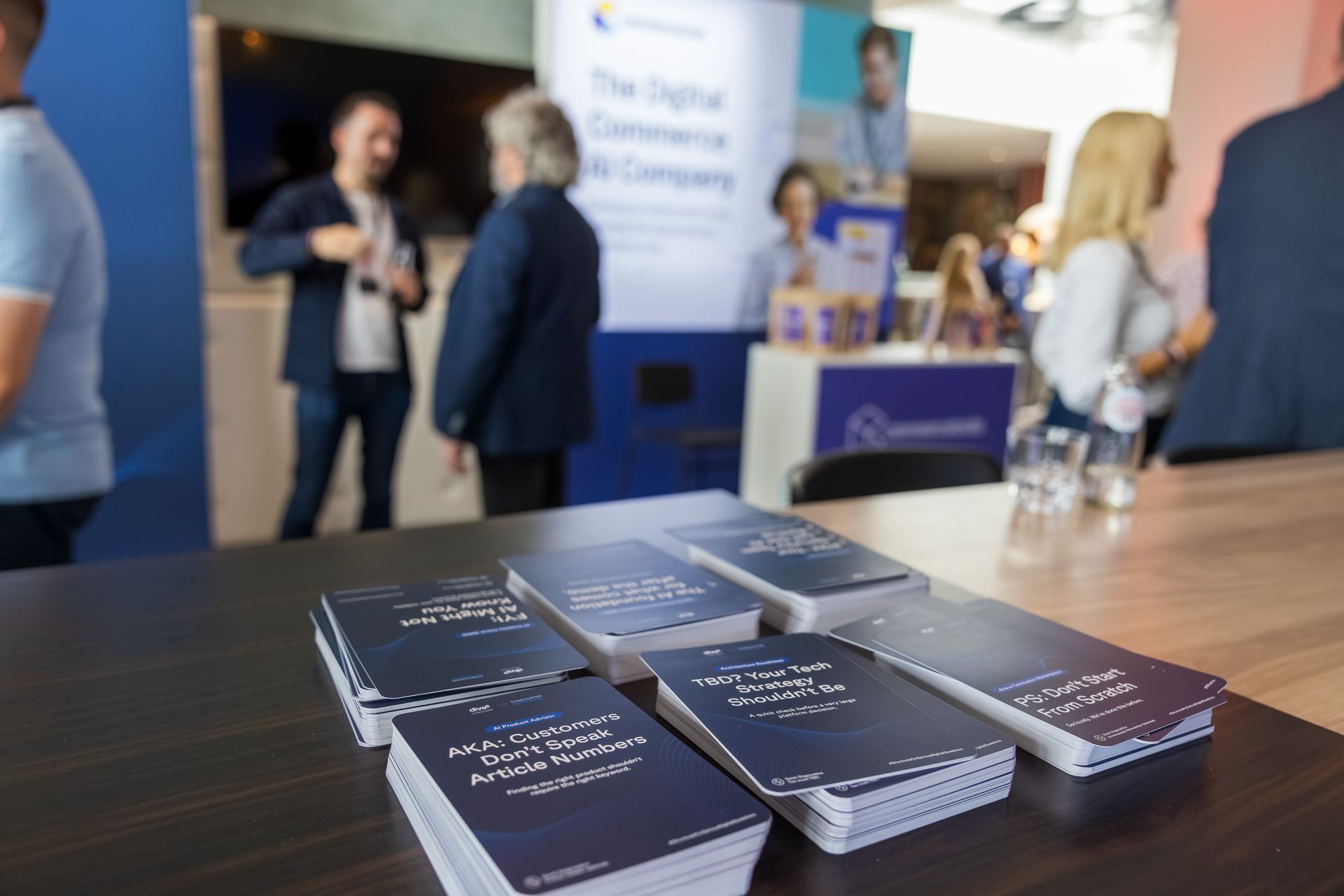

On September 17, 2026, Düsseldorf became a meeting point for more than 150 business leaders, digital pioneers, and technology experts. At Conclusion Connect, one question took center stage — a question currently top of mind for many organizations: How do you turn the vision of artificial intelligence into tangible business value?
The sessions explored this question from a range of perspectives — from AI in operations and customer experience to data, processes, and decision-making, as well as technologies such as SAP, digital sovereignty, and the transformation of complex system landscapes.
One thing became clear: the next stage of AI transformation is not about introducing as many new applications or agents as possible. What matters is identifying the right use cases, connecting data, systems, and processes in meaningful ways, and deploying AI where it creates tangible, measurable value for the business.
Four key themes emerged from the sessions and the discussions that followed:
1. AI Needs Context, Trust, and Explainable Results
Lars Rohkamm (Vodafone) demonstrated how AI can move beyond the hype and create tangible value in the enterprise. His session focused on how AI can be applied in operational environments to deliver real business impact.
Gabriel Okabayashi (Celonis) highlighted another essential prerequisite: the right context. AI can only provide meaningful support when it has access to the information and relationships that are relevant to a specific use case.
Ramon Schroeder and Verena Reineke-Rügge (diva-e Conclusion) showed what this can look like in practice using pflege.de as an example. Their session demonstrated how Agentforce can support service teams with Care Knowledge, helping them provide faster and more consistent customer support.
Mario Holt (ifm) also showed how AI can translate into tangible customer value. Using a portfolio of 15,000 products as an example, he demonstrated how customers can find the right solution faster. This is made possible by the AI Product Advisor, successfully implemented at ifm by diva-e Conclusion.
The solution addresses the limitations of traditional product search: customers do not need to know exactly what they are looking for. Instead, the AI Product Advisor considers intent, context, and technical requirements to identify relevant products more quickly — even when dealing with complex product information and data distributed across multiple systems.
Prof. Dr. Heiko Beier (MORESOPHY) showed that context is critical not only for search, but also for business decision-making, in his session “Because Decisions Matter: Evidence, Not Plausibility.” His central question: How can companies measure whether AI is actually delivering results? His answer: It is not the number of agents or automated tasks that matters, but whether they ultimately lead to better decisions. A plausible-sounding result is not enough. Especially when it comes to critical business decisions, it must remain clear which information an outcome is based on.
This puts explainability, trust, AIOps, and observability increasingly into focus. The regulatory perspective is becoming more important as well. Since the EU AI Act began taking effect in 2026, new requirements around transparency, traceability, and the responsible use of AI have become legally binding.
2. From AI Use Case to Implementation: Connecting Data, Systems, and Processes
A strong AI use case is only the starting point. To turn it into functioning business processes, data, systems, and processes need to work together.
This connection was a recurring theme across several sessions. In “SAP meets AI,” Friedrich Teucher (diva-e Conclusion) and Jules Hauspy (Donna) explored the vision of the Autonomous Enterprise — an organization where data, processes, and AI no longer operate in isolation, but work together intelligently to support or automate decisions.
This also puts the existing enterprise architecture into focus: data silos need to be broken down, backend systems connected, and processes designed so that AI can have an impact where it actually matters.
Alexander Krüger (commercetools), Dominik Heller (Best4Tires), and Manuel Bolai (diva-e Conclusion) showed in “Tired of Big Bangs?” that transformation does not necessarily require a major system overhaul. Their session explored how organizations can move from a full system replacement toward a more flexible DCX platform approach.
The session “From JSP to Headless – AI-Powered Migration for SAP Commerce,” presented by Friedrich Teucher (diva-e Conclusion), also demonstrated how AI can support transformation. AI-powered analysis can help organizations better assess migration effort, identify risks at an early stage, and make more informed decisions about the next steps.
The takeaway is clear: especially in complex system landscapes, incremental and AI-supported approaches can help organizations evolve existing structures while integrating new technologies in a targeted way. The critical step is translating technology into a concrete business case. This is where a structured AI consulting approach comes in — from identifying and prioritizing relevant use cases to assessing data, systems, and processes, and ultimately implementing and scaling the solution.
The key questions are:
What problem are we solving?
Where is the tangible value created?
What prerequisites need to be established, and how will success be measured?
This is how an AI idea becomes a robust use case — and how an experiment becomes a solution that delivers value in the real-world business environment.
3. Digital Sovereignty as a Strategic Dimension
As AI becomes increasingly integrated into the enterprise, another fundamental question emerges: How much control do organizations retain over their technological foundations?
Marcel Pereboom (Conclusion Intelligence), Sascha Sauer (diva-e Conclusion), and Thomas Stragand (Conclusion Intelligence) explored this question in their session “Independent Europe – Pathways to Digital Sovereignty.” The discussion focused on technological dependencies and how organizations can preserve their strategic room for maneuver over the long term.
The “SAP meets AI” session also demonstrated that digital sovereignty cannot be considered separately from technology architecture. The more deeply AI becomes integrated into processes, decisions, and business models, the more important it becomes to understand the data, systems, and technologies these applications depend on.
The key takeaway: achieving digital sovereignty requires organizations to consciously assess their technological dependencies and secure their digital ability to act independently over the long term.
4. AI Is Also Transforming the Customer Journey
AI is changing more than internal processes and organizational structures. It is also reshaping how customers discover brands and products.
Eike Scheibenhofer and Ning Ou (Medi GmbH) demonstrated how quickly digital interactions can evolve with a look at developments in China. Their session focused on the rapid pace of digital innovation and the increasing convergence of different channels.
With Generative Engine Optimization (GEO), this development is also becoming increasingly relevant to brand discoverability. Sven Benner (DVAG) showed how AI and large language models are changing the way brands are discovered in digital environments.
Matthias Tausendpfund (Adobe) took this idea one step further: What happens when potential customers discover and evaluate a brand without ever visiting its website?
Bastian Lopez (diva-e Conclusion) also recorded a live episode of his podcast “Entscheider” at Connect with Younes Kabbaj, Director Group Digital Transformation & eBusiness at Weleda AG. The conversation focused on how AI has changed the way the more than 100-year-old company works:
Moving from decentralised structures to a central platform
Organising teams around customer journeys rather than systems
Using AI to take over routine tasks such as code reviews
As a result, around 20% of resources could be freed up for the development of new features, making a 39-country roll-out within 12 months possible. The key takeaway: AI is less about pure cost savings and more about increasing speed and lowering the cost per feature. But making this work requires a clear vision, solid documentation and data quality, well-trained teams, and humans who retain the final decision-making responsibility.
One thing became clear: The customer journey is increasingly extending beyond traditional touchpoints. For businesses, this means rethinking both digital visibility and customer experience — and being present wherever customers use AI and emerging digital channels to find information, brands, and products.
The Next Step: Turning AI into Action
Conclusion Connect demonstrated just how broad the conversation around AI has become. Despite the many different perspectives, one common thread emerged: The key question is no longer simply what AI can do. It is where AI can make a meaningful difference — and how that difference can be measured.
For businesses, this comes down to four things: the right use case and its business value; the right data, systems, and processes; a trusted and sustainable technological foundation; and the transformation of the customer journey.
The journey from AI Vision to Business Value does not start with the next piece of technology. It starts with asking the right questions — and with the ability to deploy AI where it can make a tangible difference to the business.
Want to explore how Agentic AI can be applied in your organization? Discover the Agentic Experience Foundation (AXF) and learn how to take the next step from AI vision to implementation.
AXF provides the foundation for integrating AI agents with existing systems, data, processes, and digital touchpoints, rather than treating them as isolated applications. This turns individual AI solutions into a connected Agentic Experiencethat supports real business processes and creates tangible value.