

Most companies don't realize their digital platform is holding them back until the symptoms become impossible to ignore. Revenue stalls. Competitors move faster. Internal teams spend months on changes that should take weeks. And when leadership finally asks what went wrong, the answer is usually framed as a technology problem. It rarely is just a technology problem.
The real causes tend to be strategic: a mismatch between digital ambition and business reality, an operating model that can't support what the platform promises, structural gaps in the technology landscape that no single tool upgrade will fix, and a budget that feeds maintenance instead of growth. These problems don't announce themselves loudly. They accumulate quietly, and by the time they surface, the cost of correction has multiplied.
This post describes five patterns we see repeatedly in B2B enterprises; that signal a digital platform is no longer enabling growth but constraining it. If you recognize more than two, the conversation you need to have is probably not about tools. It's about strategy.
1. Your digital strategy solves a problem your business doesn't have
This is the most expensive mistake and the hardest to spot, because it looks like progress from the inside.
A manufacturer decides to invest in a digital commerce platform because "direct online revenue" sounds like the obvious next step. The project is approved, the budget is allocated, a vendor is selected, and the platform goes live. But twelve months later, online revenue remains marginal. The real buying still happens through distributors, through long-term contracts, through sales-assisted processes that the new platform was never designed to support.
The problem was never a missing commerce engine. The problem was that 90% of the company's growth potential sat in discoverability, product data quality, and customer intelligence. What they needed was a proper product information management strategy and a customer data platform that would increase online visibility, improve search and AI-driven findability, and give the sales team actionable insights about buyer intent. Instead, they built a storefront for a buying journey that doesn't exist at the scale they imagined.
This pattern shows up in different forms across industries:
a retailer investing in personalization technology when their product data is too messy to personalize against,
a pharma company building a patient portal when the actual bottleneck is distributor onboarding,
a building materials supplier launching a B2C-style self-service shop when their customers need guided configuration and quote workflows.
The common thread is a digital strategy that imports assumptions from other industries or other business models instead of starting from how the company creates and captures value.
When your digital strategy doesn't match your revenue architecture, every Euro you spend on it moves you sideways rather than forward. Meanwhile, the competitor who understood their own model first is pulling ahead, not because they spent more, but because they spent it on the right problem.
2. Your platform promises more than your operating model can deliver
A platform can have every feature on the requirements list and still fail if the organization behind it can't operate it. This is the gap between capability and capacity, and it's one of the most common reasons digital initiatives stall after a promising start.
In practice it looks like this:
The platform supports dynamic pricing, but nobody in the organization has defined the pricing rules or owns the pricing process.
The CMS allows personalized content, but the marketing team has three people and they're already overwhelmed maintaining the baseline.
The system offers sophisticated analytics, but there is no one on the team who can interpret the data, let alone act on it.
The integration layer exists in theory, but the internal IT team lacks the API expertise to connect anything beyond the basics.
The result is a platform running at a fraction of its potential, not because of technical limitations but because the operating model was never designed to match. Teams lack the skills, the headcount, or the mandate to use what was built. Processes that should be automated remain manual because no one was assigned to define the automation rules. Features that were central to the business case go unused because the people who were supposed to own them were never hired or trained.
We explored this dynamic in an earlier article (Link: Tech-Evaluation im Zeitalter von KI: Plattformentscheidungen neu denken | diva-e Conclusion) about why customer experience alone is not a business model. The argument holds here as well: if your operating model can't support the experience your platform is supposed to deliver, you don't have a scaling problem. You have a readiness problem. And solving it requires an honest assessment of internal capabilities before investing in the next platform upgrade.
A target operating model (TOM) for digital has at least eight dimensions. However, most platform decisions only address the last two.
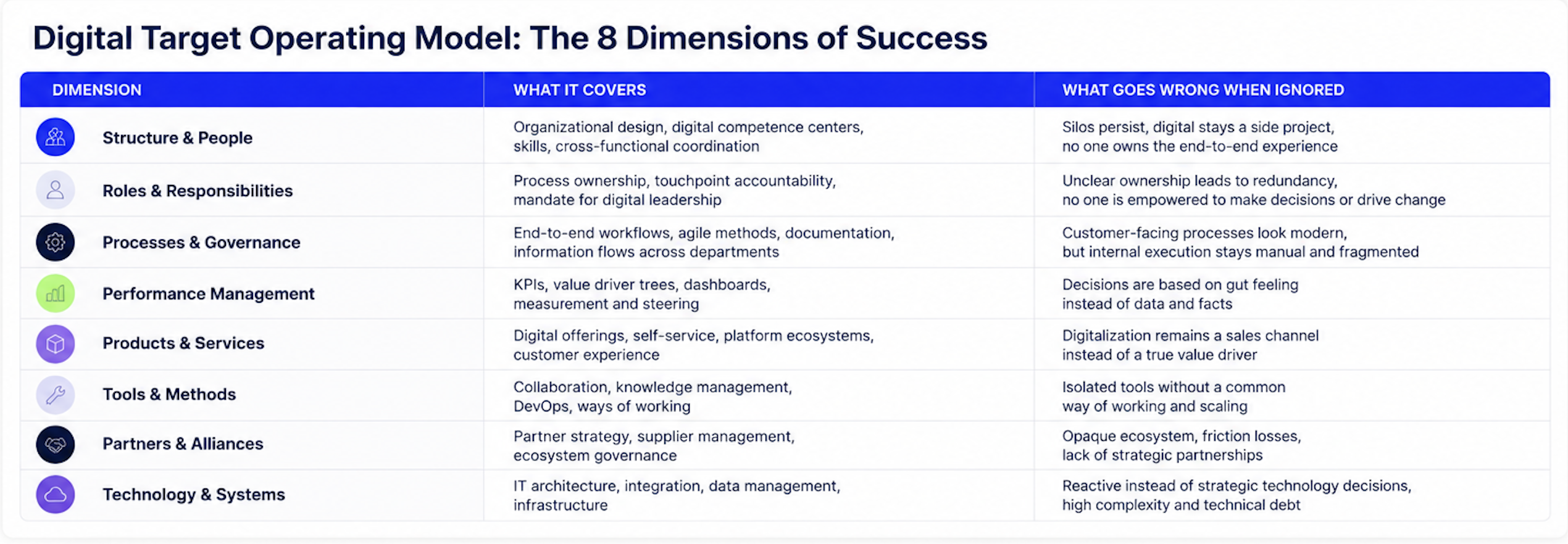
When a platform decision only covers "Technology and Systems" and perhaps "Tools and Methods," the other six dimensions remain in their current state. The new platform arrives in an organization that was not reshaped to use it. That is why readiness assessments that span all eight dimensions are more predictive of project success than any feature comparison.
3. Your tech stack has gaps that no single tool will fix
Sometimes the issue isn't that the tools are wrong. It's that the space between them is empty.
Many enterprise technology landscapes grew organically over years.
an ERP here,
a commerce platform there,
a CRM added later,
a PIM bolted on when product data became unmanageable.
Each system works in isolation. But the connective tissue that would make them work together, the middleware, the orchestration layer, the event-driven integration that lets data flow where it needs to go when it needs to get there, was never built.
The symptoms are predictable:
manual data transfers between systems
inconsistent product information across channels
pricing discrepancies between the shop and the ERP
customer data that lives in four different databases with no single source of truth.
These problems don't get better when you upgrade one of the systems. They get better when you invest in the layer between them.
The same applies to data-driven capabilities. Many organizations have tools that generate data but lack the infrastructure to turn that data into decisions. They have traffic numbers but no attribution model. They have CRM records but no customer lifecycle analysis. They have order history but no predictive demand signal. The data exists across fragmented systems, and without a deliberate data architecture that brings it together, it stays fragmented regardless of how modern each individual tool is.
In an earlier article, we argued that architecture outlives tools. This is one of the most concrete manifestations of that principle. The tools can be perfectly adequate. If the architecture between them is missing, the whole landscape underperforms, and adding another tool on top only increases the complexity without solving the structural deficit.
4. Your budget feeds the past instead of the future
There is a simple test for whether your digital platform is enabling growth or consuming it: look at where the money goes.
In many organizations, 70 to 80 percent of the digital budget is spent on maintenance, operations, and fixing what already exists.
Patching technical debt
Working around limitations of the current stack. Managing upgrades that were deferred too long
Keeping integrations alive that were built as temporary workarounds five years ago and are now load-bearing infrastructure.
What's left for innovation, for the projects that would drive growth, is a fraction. And that fraction gets further diluted by competing priorities, unclear ownership, and backlogs so long that new ideas wait months before anyone even scopes them.
The competitive consequence is real. While your team spends six months migrating to a new version of a platform you've already outgrown, a competitor with a cleaner architecture ships a new customer-facing capability every quarter. The gap doesn't close. Every year of deferred architectural cleanup makes the next year's maintenance burden heavier, and the share of budget available for growth shrinks further.
This is usually the sign that resonates most with CFOs, because it translates directly into a financial conversation. The question is straightforward: what percentage of your digital spend creates future value, and what percentage preserves past decisions? If the ratio is 80/20 in favor of the past, your platform has become a liability, regardless of how good it looked when you selected it.
5. You can't tell whether your platform is working
This may be the most uncomfortable sign of all, because it means the other four could be present and you wouldn't know.
Many organizations lack the measurement infrastructure to evaluate whether their digital platform is delivering business value. They have dashboards, but the dashboards show activity metrics like:
page views
session counts
order numbers
They track what's happening but not why it's happening, what it's costing, or what they should do differently.
A proper performance management framework goes beyond analytics. It defines value streams: the end-to-end paths from investment to outcome.
Rather than focusing solely on conversion rates, it answers questions such as:
What is the cost of acquiring a qualified lead across different channels?
How long does it take to move from the first digital touchpoint to a signed contract?
Which digital initiatives demonstrably contribute to revenue growth?
Without this infrastructure, every strategic discussion about the digital platform becomes an opinion contest. Someone says the platform is underperforming. Someone else says it needs more time. A third person suggests replacing it entirely. None of them can prove their position because the data to do so was never collected, structured, or made accessible.
If you cannot answer the question "is our digital platform contributing to growth, and by how much?" with specifics, then every other diagnosis in this post is a guess. And acting on guesses at the budget levels is a risk that boards should not accept.
What these signs have in common
Notice that none of the five patterns above are primarily about technology:
A wrong strategic focus is a leadership problem.
An undersized operating model is an organizational problem.
Missing middleware is an architecture problem.
Budget consumed by debt is a governance problem.
Absent measurement is a management problem.
The technology becomes the visible symptom, the thing that feels slow, that frustrates teams, that gets blamed in steering committees. But replacing the technology without addressing the underlying cause will reproduce the same problems on a new stack, usually faster and at a higher cost than the first time.
If you're seeing these patterns, the productive next step is not a new vendor evaluation. It is an honest assessment of whether your strategy, your architecture, your operating model, and your measurement infrastructure are aligned with each other and with your actual business.
We've written about how to approach this in the earlier posts of this series: why architecture must come before tools, and how to structure a platform selection that starts with strategic clarity rather than feature comparisons. This post adds the diagnostic lens. Together, they form a foundation for the conversation that most digital transformations need but rarely get: the one that starts with "what is actually going wrong" before jumping to "what should we buy next."
Stop treating symptoms. Start diagnosing the system. As an independent implementation partner, we help organizations answer the right questions in the context of their specific business model.