

Anyone who sells complex products or products that require explanation online is familiar with the problem: Customers often don’t know exactly what they’re looking for. Traditional search functions either return too many results or none at all; technical product names make the search even more difficult; and potential buyers leave the store frustrated before they find the right product.
This is exactly where the AI Product Advisor comes in: It transforms the traditional product search into an intelligent shopping experience that understands the target audience’s actual search intent and provides relevant product recommendations directly within the store. Instead of responding only to keywords, the Advisor also considers context and specific requirements.
Why Traditional Onsite Search Reaches Its Limits With Complex Products
Many e-commerce businesses manage extensive product catalogs, with information distributed across multiple systems such as PIM, CMS, or DAM platforms. At the same time, traditional product search often relies solely on keyword matching.
In practice, this creates several challenges:
A high number of searches with no results
Low conversion rates
High bounce rates
Difficult product discovery for technical or complex product portfolios
Significant manual effort required to optimize search performance
To overcome these limitations, many companies have turned to AI-powered search and chat solutions. However, these often introduce a new challenge: users are redirected away from the familiar shopping experience into a separate chat interface. These interruptions create friction in the customer journey and can negatively impact the overall shopping experience.
The Product Advisor takes a different approach. Instead of evaluating search queries based solely on keywords, it understands user intent, context, and technical requirements directly within the existing shopping experience. At the same time, it connects relevant product data from multiple systems and integrates seamlessly into the existing shop architecture. This allows businesses to keep their current infrastructure while enhancing it with an intelligent search layer—without complex migrations or replacing existing systems.
Use Case: The Product Advisor for Complex B2B Product Portfolios
Example: A manufacturer sells technical fastening components through its B2B online shop. The catalog includes several thousand product variants with different specifications, while product information is spread across multiple systems.
The challenge: Customers know the technical requirements they need to meet, but they often don't know the exact product names. As a result, traditional search quickly reaches its limits. Searches frequently return no relevant results, potential buyers abandon the purchasing process, and the sales team receives numerous inquiries about products that are already available online. At the same time, continuously optimizing the search function requires considerable manual effort.
This is where Smart Search powered by the Product Advisor becomes a competitive advantage. The Product Advisor connects existing data sources and interprets search queries based not only on individual keywords but also on context and technical relationships. As a result, customers receive relevant product recommendations faster—without ever leaving the familiar shop environment.
Businesses benefit throughout the entire customer journey:
Faster product discovery: Prospective customers find the right products more quickly without trying multiple search terms or browsing through long lists of results.
Fewer searches with no results: Context-aware query interpretation significantly reduces searches that would otherwise return no or irrelevant results.
Higher customer satisfaction: More relevant product recommendations keep customers engaged throughout the buying process and create a more intuitive shopping experience.
Improved conversion rates: The faster customers find the right product, the more likely they are to complete their purchase.
Smarter product search not only improves the customer experience but also supports key business objectives, creating a lasting competitive advantage:
Higher search conversion
Increased revenue per search
Continuous optimization through self-learning AI
A scalable foundation for future AI use cases
The Product Advisor combines an intuitive shopping experience with measurable business outcomes, making Smart Search a true competitive advantage for businesses with complex product portfolios.
Seamless Integration Without Replacing Existing Systems
One of the key advantages is that businesses do not need to modernize their entire IT landscape.
The AI Product Advisor is specifically designed to connect existing systems such as PIM, CMS, and DAM platforms while making intelligent use of their data. This enables businesses to significantly improve product search without launching a complex replatforming initiative.
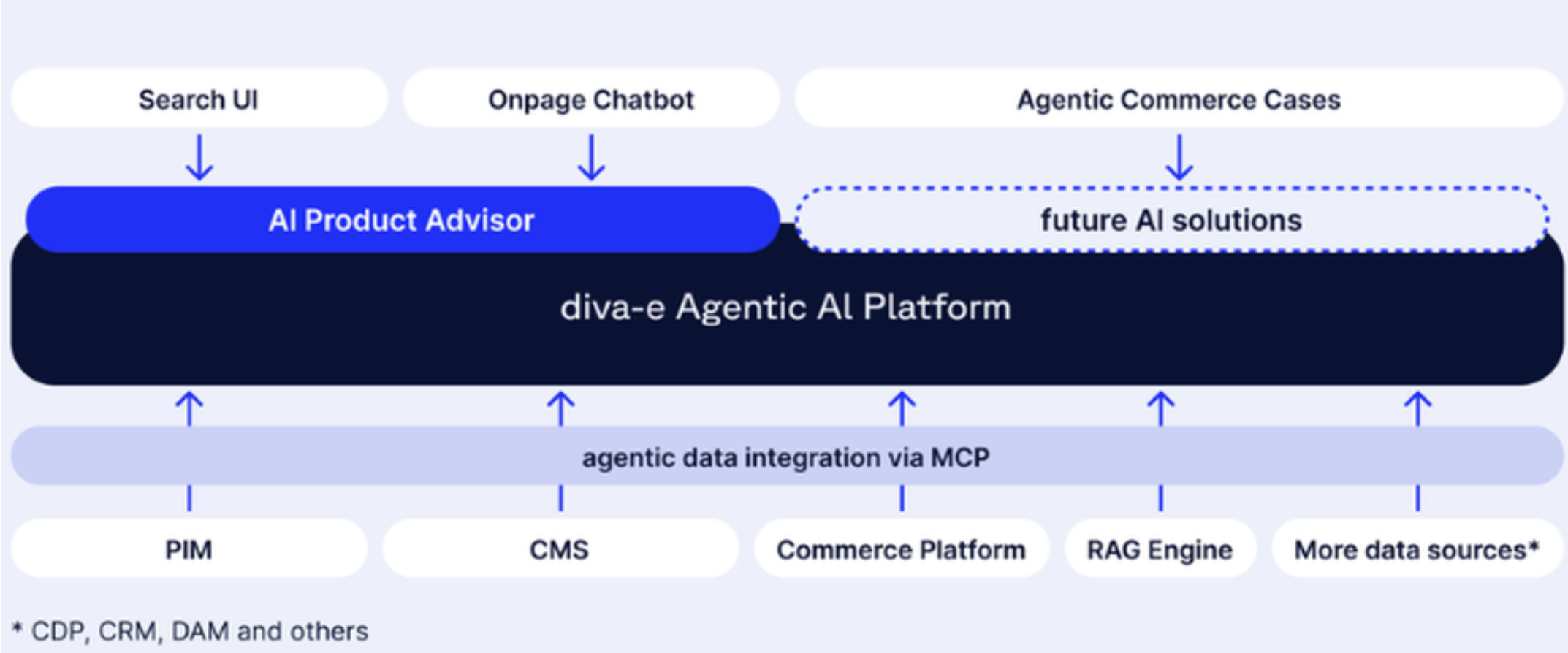
Implementation follows a structured, step-by-step approach:
Connect existing systems and define relevant KPIs
Integrate and enrich product and contextual data
Embed the solution into the existing shopping experience
Validate performance and results
Continuously optimize through feedback and A/B testing
Conclusion: Turn Your Product Search into a Competitive Advantage
For businesses with complex product portfolios, traditional keyword-based search is no longer enough. Today's customers expect online shops to understand their intent and guide them quickly to the right product.
The Product Advisor is built to do exactly that. By intelligently interpreting search intent, connecting distributed data sources, and integrating seamlessly into existing shop systems, it makes product search more effective while increasing conversions, customer engagement, and revenue—all without requiring businesses to replace their existing technology stack.
Ready to make your product search smarter? We'll analyze your requirements and show you how the Product Advisor can be seamlessly integrated into your existing system landscape—for more intelligent search, happier customers, and measurable business results.