

In the first post of this series, we argued that architecture should come before tools: Platform decisions do not fail because the wrong tool gets picked, but because architecture enters the conversation too late. Fair enough. But at some point, you have to pick a tool.
The question is how. And for most organizations, my honest answer is: often badly. A CTO reads a Gartner report. A project lead attends a vendor event. Someone in procurement remembers a name from a previous job. Three demos get scheduled. Features get compared in a spreadsheet. The tool with the best demo wins.
This post describes a different approach. One that starts with your own strategic context, reduces the market systematically before you ever talk to a vendor, and ends with a shortlist that represents genuinely different architectural options rather than three flavours of the same thing.
Start with what you know, not with what the market offers
The MarTech universe today contains thousands of tools across hundreds of categories. If you start by scanning that landscape, you are already lost. The volume is paralyzing, the categories overlap, and every vendor positions itself as exactly what you need.
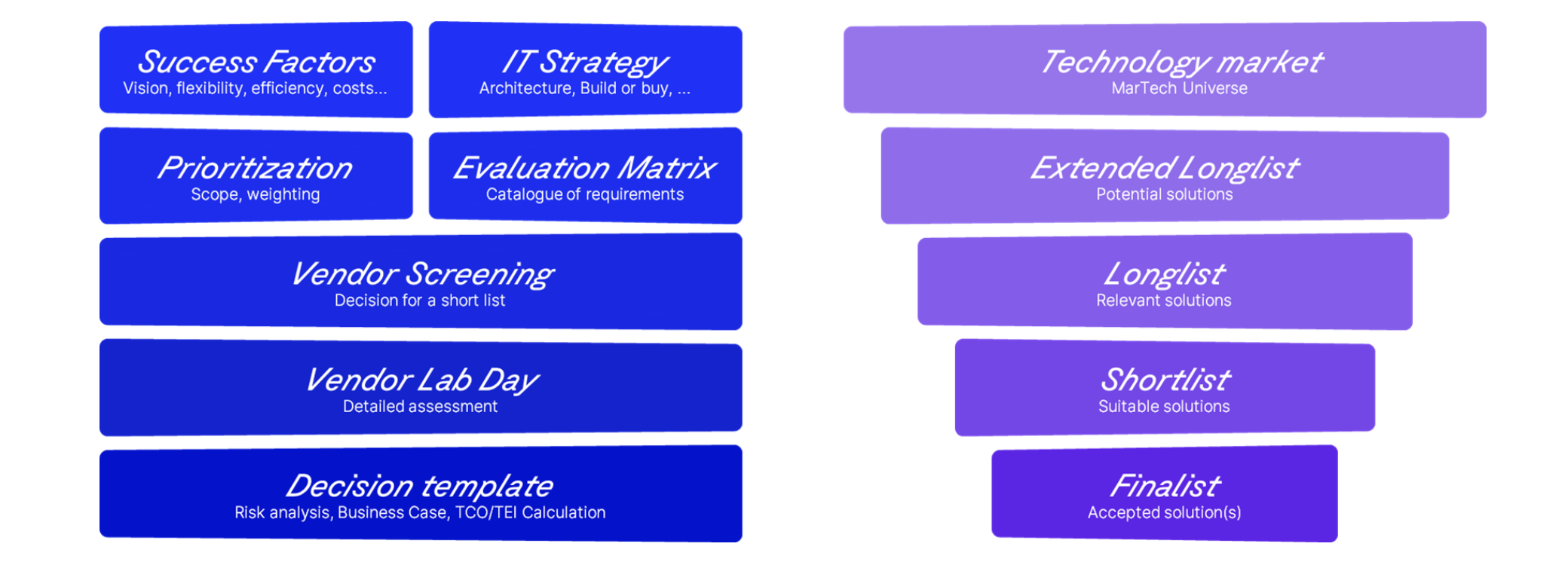
The reduction has to begin on your side, not theirs. That means clarifying two things before you look at a single product:
Your success factors. What does a good outcome actually look like? Not in feature terms, but in business terms. Vision, flexibility, efficiency, cost structure, time to value. These are the criteria that will matter in three years when the project is either working or not. They need to be explicit, weighted, and agreed upon across your leadership team before the first vendor conversation happens.
Your IT strategy. What is your architecture vision? Build or buy? Cloud-native or hybrid? Monolithic or composable? Best-of-breed or suite? These are more than technical preferences; they are strategic constraints that eliminate entire categories of tools. A company that has committed to a composable, API-first architecture does not need to evaluate monolithic suites, no matter how impressive the demo.
These two inputs alone, success factors and IT strategy, should reduce the full technology market to what we call an extended longlist: a set of potential solutions that are at least theoretically compatible with your direction. In practice, this step alone eliminates 80 to 90 percent of the market. Not through analysis, but through clarity.
Prioritize before you evaluate
Most evaluation processes jump from "here are some options" to "let's compare features." That is premature. Before you build a detailed evaluation matrix, you need to prioritize what matters.
Not everything on your requirements list carries the same weight. Some requirements are true must-haves: capabilities without which the platform cannot serve your business. Others are important but negotiable. And some are nice-to-haves that should never influence a strategic decision but somehow always do.
The discipline here is scope and weighting:
Which requirements are non-negotiable?
Which ones matter most for the first phase versus the long-term roadmap?
How do you weigh operational fit against functional richness?
How do you balance total cost of ownership against speed of implementation?
This prioritization, combined with a structured evaluation matrix, is what reduces the extended longlist to a true longlist of relevant solutions. At this stage, you are still not talking to vendors. You are comparing documented capabilities, published architectures, and reference cases against your weighted criteria. The tools that don't meet your must-haves fall away. The ones that remain are worth investigating further.
Why analyst reports might help less than you think
At this point in the process, most organizations reach for analyst reports. Gartner Magic Quadrants, Forrester Waves, IDC MarketScapes. They are useful inputs. But they are dangerous as decision tools.
Analyst reports evaluate vendors against a generalized set of criteria, weighted for a generalized market. But: Your business is not generalized. Your requirements, your operating model, your integration landscape, your internal capabilities: all of these are specific. A vendor that sits in the upper right of a quadrant may be a terrible fit for your context. And the reports themselves often contain contradictions that most readers skip over.
Example: In a recent well-known B2B commerce evaluation, one analyst firm positioned a vendor as a clear market leader in its visual ranking while noting in the body of the same report that the vendor lacked core B2B functionality.
These are not just minor footnotes but fundamental qualifications that directly affect whether that vendor is right for your business. Because most readers only look at the quadrant visual and never read the twenty pages behind it, these qualifications might get lost. The upper-right position becomes a proxy for quality, and the nuance disappears.
Analyst reports are research inputs, not shopping guides. Read the full text. Read the cautions. Read what the analyst says the vendor is not good at. That is where the real insight lives.
The shortlist should represent options, not variations
Here is where most selection processes go wrong. They narrow down to three vendors that all look roughly the same: similar feature sets, similar positioning, similar architecture. The decision then comes down to price, demo quality, or personal preference. None of which are strategic criteria.
A better shortlist represents three fundamentally different approaches to solving your problem. In B2B commerce, for example, that might look like this:
One option built on open source, offering maximum ownership and customization depth, requiring significant internal development capacity but giving you full control over your roadmap and your data.
One SaaS platform, offering operational simplicity, fast deployment, and predictable cost, trading control for convenience and accepting that your differentiation happens in configuration rather than code.
One specialized best-of-breed platform, built deeply for your specific domain, with strong out-of-the-box process coverage but a smaller ecosystem and potentially higher switching costs.
These three options force a real strategic conversation. They are not about which feature list is longer. They are about what kind of organization you want to be: one that builds, one that rents, or one that buys deep expertise. That is a decision worth making at the leadership level.
And here is the part that surprises most evaluation teams: within each of these categories, the tools are often remarkably similar. The differences between two open-source commerce platforms might come down to programming language and community size. The differences between two SaaS offerings might be a matter of ecosystem maturity. These are real differences, but they are execution-level, not strategy-level. The strategic decision happens one level up.
Evaluate context, not features
Once you have your shortlist, the temptation is to build a massive feature comparison matrix. Hundreds of rows, weighted scores, color-coded cells. It feels rigorous but might be misleading. Features converge. Most mature platforms in a category cover 80 to 90 percent of the same functional ground. What actually differentiates them is context: for whom is this the right platform, and for whom is it the wrong one?
That is why we use a different evaluation lens. For each shortlisted platform, we assess four dimensions:
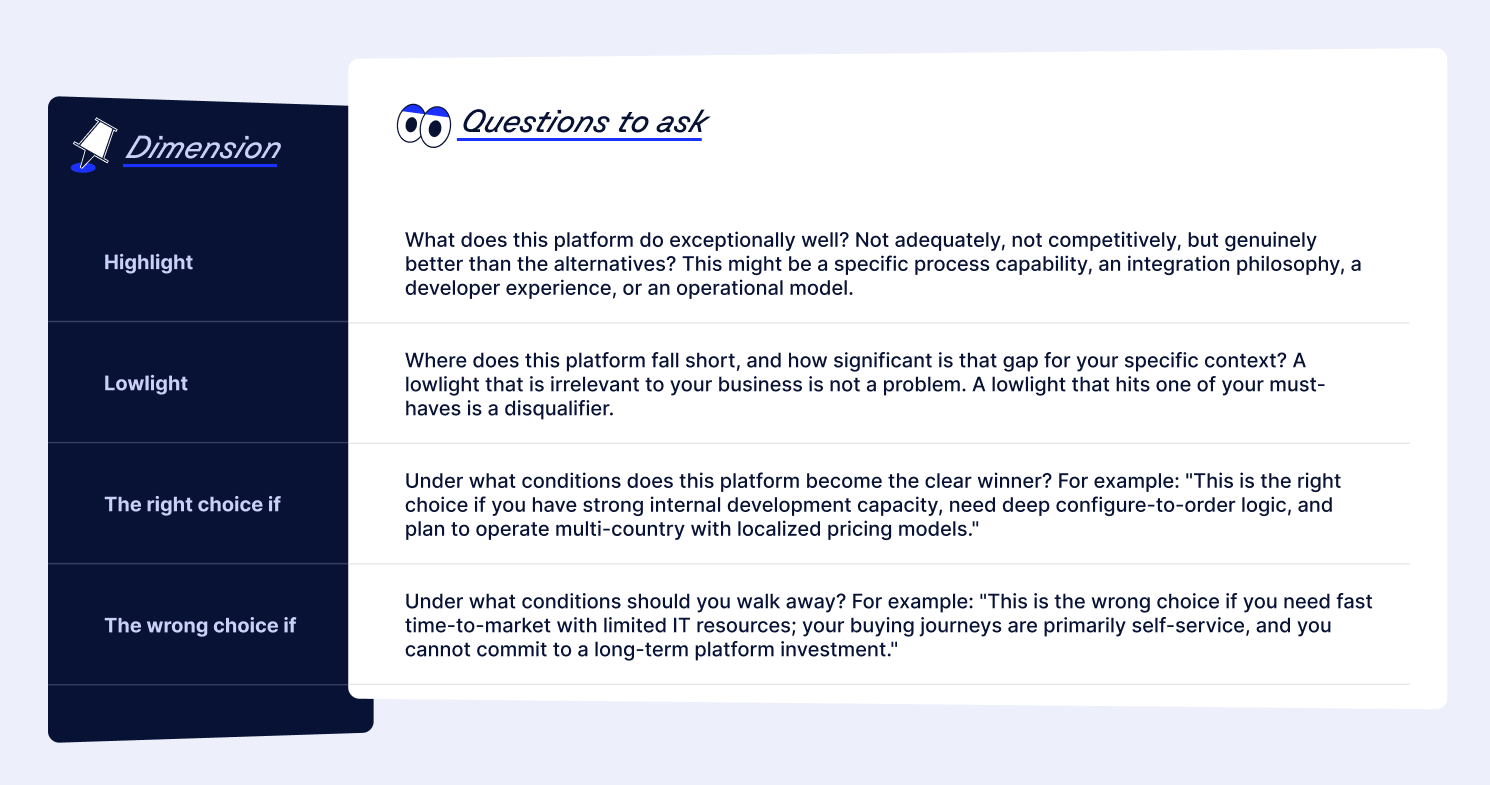
This framework forces honesty. It prevents the common failure mode where a platform gets selected because it scored highest on a feature matrix, only to fail because the organization was not ready to operate it. The "right choice if" and "wrong choice if" dimensions surface fit, not just capability. And fit is what determines whether a platform succeeds in practice.
Use every intelligence source you have
Analyst reports are one input. Your own criteria are another. But there are two more sources that are underused.
Your industry peers: Other manufacturers, retailers, or service companies who have been through the same decision recently.
Not vendor-curated reference calls where the customer has been briefed, but genuine peer conversations about what worked, what didn't, and what they would do differently. Industry associations, conferences, and informal networks are better sources of truth than any vendor reference list.
Technology-agnostic system integrators:Implementation partners who work across multiple platforms and have no commercial incentive to push one over another.
They see patterns across dozens of implementations and can tell you where a platform shines and where it breaks, based on actual project experience rather than product roadmaps. The key qualifier is "agnostic." If your advisor only knows one platform, they will recommend that platform. Every time.
The real reduction
Let's be honest about what "1000+ to 3" actually means.
It means that most of the work happens before you ever talk to a vendor.
Success factors and IT strategy eliminate the vast majority
Prioritization and a structured evaluation matrix narrow the rest.
Vendor screening, informed by analyst research, peer input, and independent advice, gets you to a shortlist.
And that shortlist, if you've done it right, doesn’t contain three similar tools ranked by feature count. It contains three different answers to an architectural question. The decision between them is not a scoring exercise but a strategic choice about ownership, operating model, and where you want your differentiation to live.
The final step, the vendor lab day and decision template with its risk analysis, business case, and TCO calculation, is important. If you've done the upstream work, the finalist should feel inevitable rather than surprising. Stop comparing features. Start comparing futures.
The real differentiator is not the feature list, but the strategic opportunities a technology creates for your business. As an independent implementation partner, we can help you navigate this decision and identify the option that best fits your goals.